
Political and advocacy agencies across the Philippines and APAC are discovering a new business channel: inbound. Not the old brochure site. A content engine that answers real operator questions—how do we segment for barangay canvass? how do we survive an algorithm mood swing?—and shows up when a campaign manager searches at midnight. Generative Engine Optimization (GEO) and classic SEO now sit in the same job: be the clearest, most citeable, most human answer in a market flooded with generic marketing sludge.
Neuwark Communications builds belief systems—and we publish like operators, not like keyword farmers. We don't decorate agendas. We engineer belief. Your agency content should do the same for your own pipeline: teach hard truths, demonstrate craft, and invite a conversation without begging.
Why most agency SEO sounds like it was written by no one
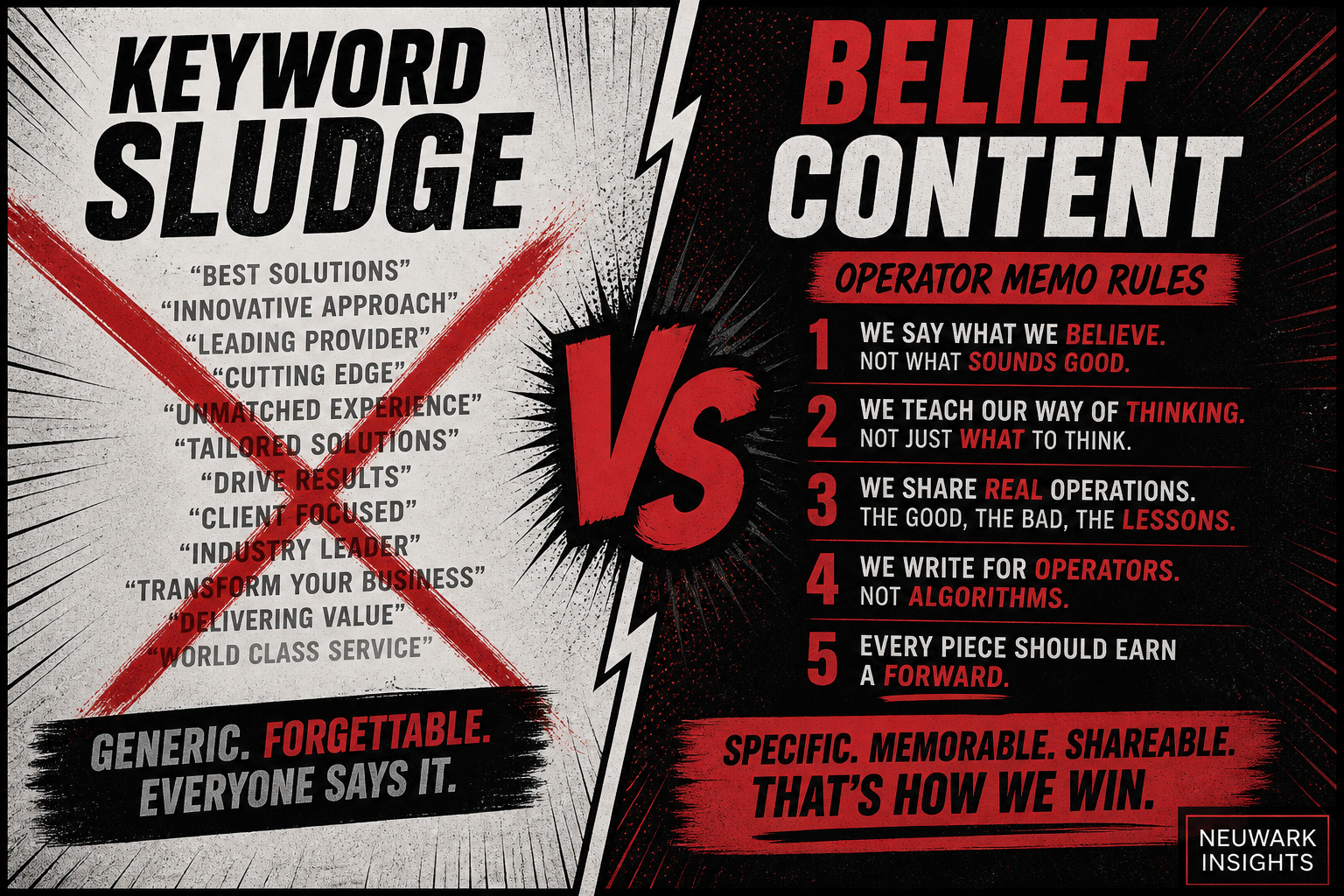
The failures are predictable:
- Interchangeable expertise. Articles that could sell SaaS, vitamins, or "growth hacking" with the logo swapped.
- Keyword stuffing without a point of view. Ranking for "political consulting Philippines" while saying nothing a field director could use Monday.
- AI mush with no scars. Smooth paragraphs that never mention monsoon OOH, vernacular radio, ad-policy friction, or coalition ego.
- Hard-sell CTAs that break trust. Every H2 ending in "Book a demo" teaches readers you are extracting, not teaching.
- No entity clarity for GEO. Generative answers cite sources that are specific, structured, and consistent. Vague thought leadership does not get retrieved.
Operator rule: if a campaign organizer would not forward your article to a tired deputy, it is not inbound content. It is content cosplay.
What "GEO + human SEO" means in practice
Think of two audiences at once:
1. Retrieval systems (search indexes, AI overviews, answer engines) that reward clear entities, question-shaped headings, original frameworks, and quotable rules. 2. Human operators who reward honesty, local texture, and kits they can steal.
Win both with the same artifact: an article that defines terms, states an operator rule in bold, shows a field kit, and uses PH/APAC particulars that generic global blogs will not invent.
Building the engine: cadence, clusters, and craft
Cluster around jobs, not vanity keywords. Examples: message systems, paid media shocks, crisis floods, volunteer discipline, fundraising trust, research-to-media loops. Each cluster gets a pillar + supporting pieces that interlink with purpose.
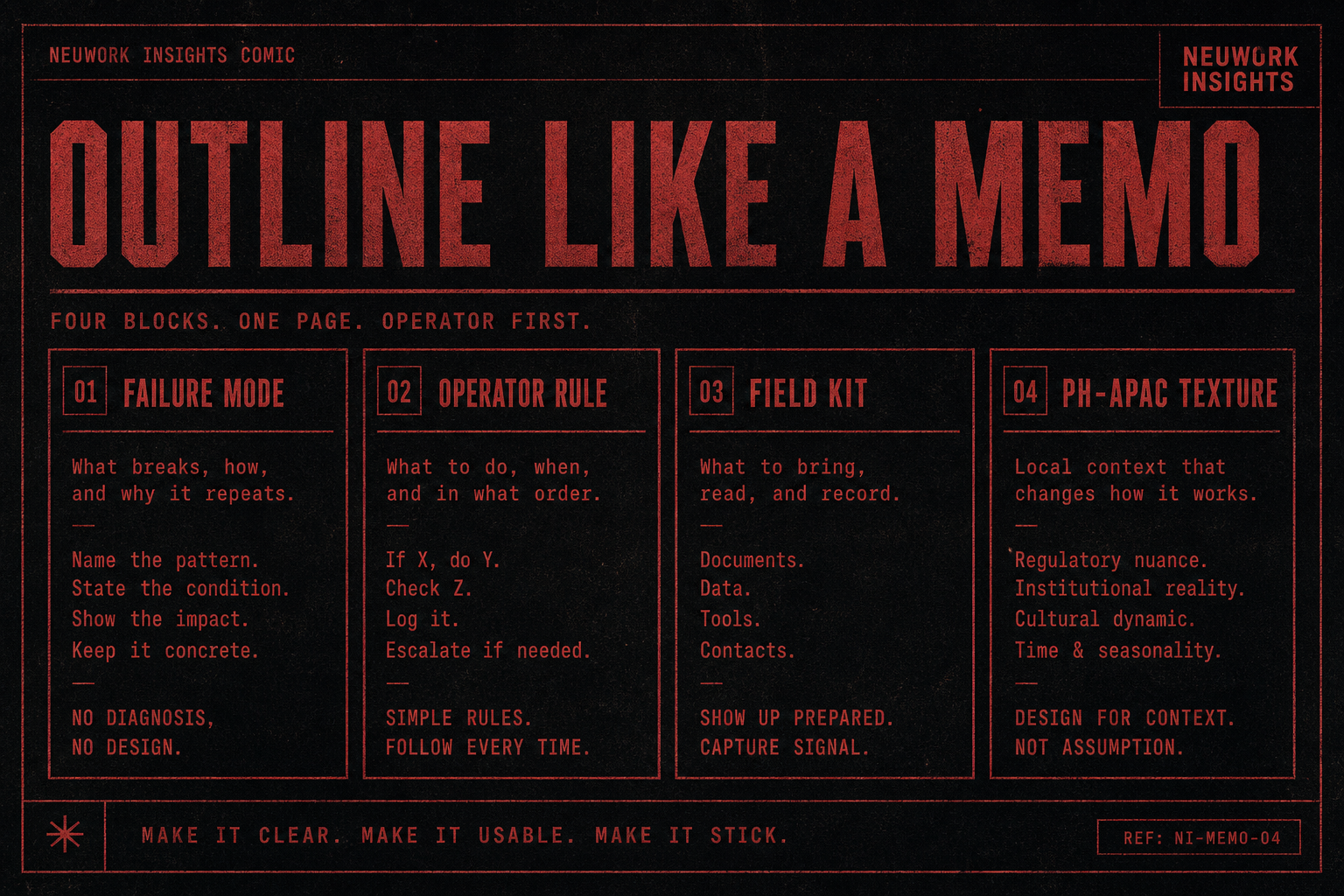
Outline like an operator memo.
- Name the failure mode in the first screen.
- State your stance (who you serve; what you refuse).
- Teach a framework with named parts.
- Add a Monday field kit.
- Pressure-test with hostile conditions.
- Close with a soft CTA that offers help, not hype.
Write human on purpose. Keep vernacular reality, concrete objects (jeepney stickers, barangay PA, e-wallet receipts), and sentences with rhythm. Cut empty intensifiers. Prefer "operator rule" over "in today's ever-evolving landscape."
Structure for citation. Short definition blocks, numbered systems, FAQ-style H3s, consistent agency entity mentions, and original phraseology ("message system, not slogan"; "algorithm mood swing") that can become associated with you.
Distribute like a campaign. Publishing is not distribution. Seed to LinkedIn thoughtfully, to partner newsletters, to practitioner communities—without turning every post into a billboard.
Soft CTA discipline (because inbound is still trust)
Hard CTAs train bounce. Soft CTAs invite the right clients:
- "If your plan is still X, start a conversation."
- "If your deck cannot survive a doorstep, talk to us."
- One contact link. No countdown. No fake scarcity.
The content did the selling by being useful. The CTA only opens a door.
Measurement that doesn't turn you into a content farm
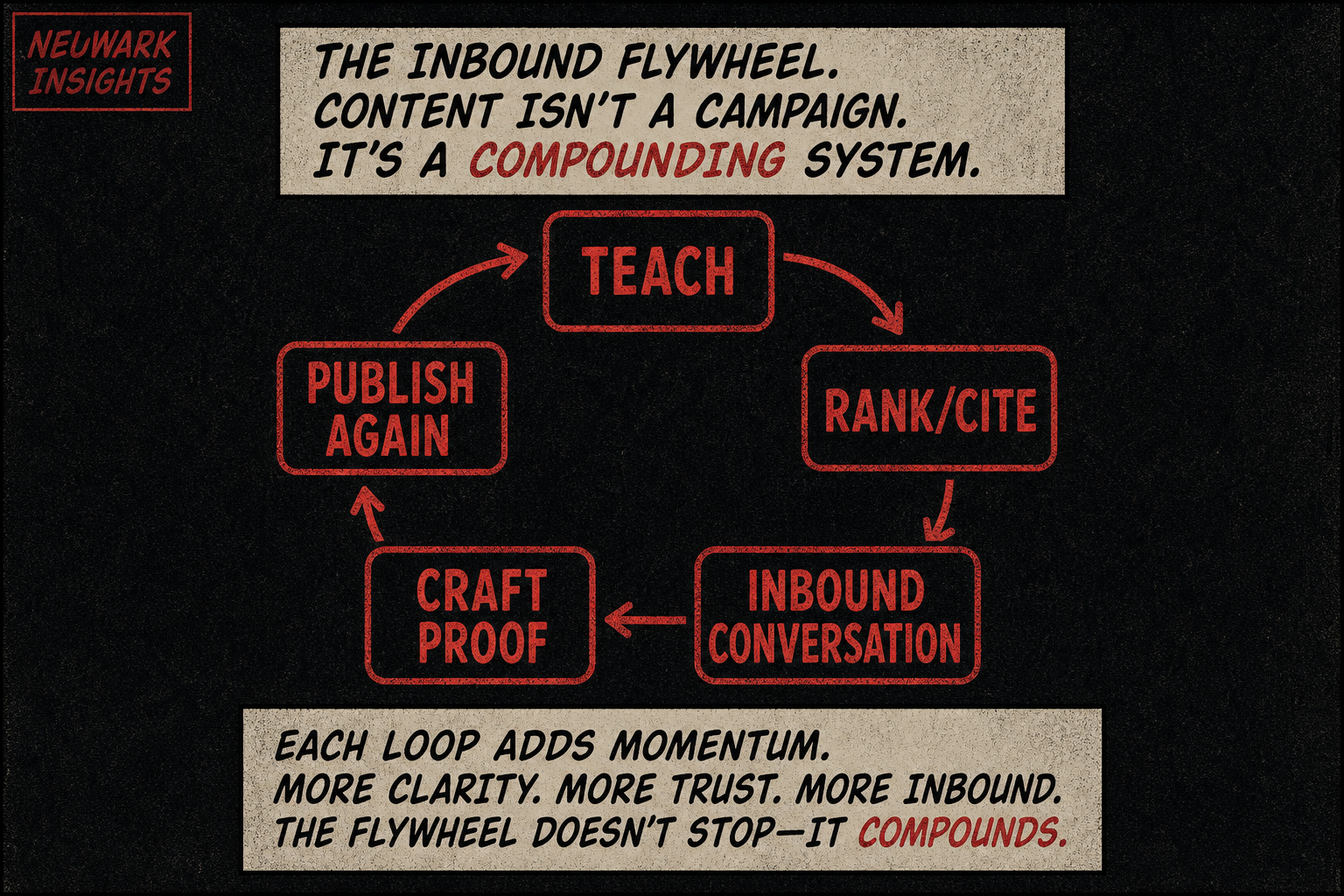
Track what matters for an agency:
- Assisted conversations and qualified inbound, not only sessions.
- Branded search lift for your frameworks.
- Referral quality (campaigns vs. tire-kickers).
- Evergreen pieces that keep earning cites after the news cycle moves.
- Internal reuse: do sales and delivery teams actually send these articles?
Kill pieces that rank for irrelevant queries. Double pieces that create replies like "we are living this exact failure." That reply is the GEO/SEO north star for professional services in politics: being findable for the problem you are uniquely good at fixing.
APAC particulars worth baking into the engine
- Bilingual / vernacular search behavior (English query → local decision culture).
- Platform-policy sensitivity—write so pages remain useful even when social distribution throttles.
- Public-interest ethics: you are modeling the communications standard you sell.
- Local proof: Manila ≠ Cebu ≠ Davao ≠ diaspora chats; say so when it changes the advice.
A 30-day standup plan for a lean agency team
Week 1: pick three job clusters; inventory existing drafts; define entity pages (services, about, contact) with consistent naming.
Week 2: ship two operator articles with field kits and soft CTAs; interlink to services without stuffing.
Week 3: add one pillar refresh; capture FAQs from real sales calls as H3s; fix titles that sound like press releases.
Week 4: measure assisted conversations; prune one useless post; double the piece that earned practitioner replies; package a PDF field kit as a polite lead magnet only if the article already gave away the useful core.
Do not outsource your point of view. Freelancers can help with drafts; they cannot invent your scars. The GEO era rewards distinctive, citeable expertise. Generic agencies will rank for a while on volume and then disappear into the model's average. Specific agencies become the cited source.
Original frameworks beat recycled tips
Search and generative systems increasingly summarize the average of the web. Your defense is named intellectual property: message systems, portfolio theory for paid shocks, trust stacks for fundraising, field-usable segments. Coin the rule, teach it, repeat it across cluster pieces, and show PH/APAC application. That is how an agency becomes citeable instead of interchangeable.
Also maintain a living "scrap" list of phrases you refuse—growth-hack clichés, empty progressive wallpaper, fake urgency. Style discipline is SEO now, because mush does not get trusted enough to convert even when it ranks.
Be the answer people trust enough to click—and call.
Inbound for political agencies is not a blog hobby. It is a belief engine pointed at your own future clients. Build clusters that teach. Write like someone who has been in the room. Optimize for retrieval without sanding off your voice. Soft-ask when the teaching is done.
Neuwark Communications publishes and operates this way because we want partners who care about craft under pressure. If your agency site still reads like a generic consultancy with a flag emoji, start a conversation with us—or steal this engine and go build.
[Start a conversation →](https://neuwarkcommunications.com/contact)