Volunteers win Philippine races more often than clever ads. That is not romance—it is logistics. A barangay canvass is where persuasion meets humidity, dogs, gated compounds, and a tita who has already heard three versions of your candidate from the sari-sari group chat. If your field team freelances language at the door, you do not have a campaign. You have a rumor with name tags.
What HQ owes the people doing the walking
Message discipline collapses when logistics collapse. Volunteers who lack water, safe routes, accurate house lists, or a real escalation path for hostile encounters will invent language because language is the only thing they still control. Pair the one-pager with: safety protocol, GC etiquette, and a named person who answers within the shift.
Reward hierarchy fidelity in shout-outs and leadership tracks. If you only celebrate the funniest door story, you train comedy. If you celebrate the cleanest ask conversion with frame intact, you train operators.
Neuwark Communications builds political and advocacy communications for operators who need belief that travels from HQ to the last purok. Message discipline at the canvass is not about silencing volunteers. It is about giving them a spine strong enough to remix under pressure without inventing a new campaign on every gate.
Why barangay canvass breaks weak messaging
Doorstep conversations are hostile to slogans. People interrupt. They change languages mid-sentence. They ask about a road, a scholarship, a relative’s case, a viral clip from last night. Metro Manila density, Visayas island hops, Mindanao trust networks—each ecology punishes different mistakes—but the failure mode is shared: volunteers fill silence with improvisation.
Improvisation feels authentic. Voters often punish it as incoherence. When one volunteer leads with “good governance,” another with “jobs,” and a third with a personal attack your strategy desk never cleared, the household does not hear passion. They hear a campaign that has not decided what it is.
Operator rule: if a volunteer cannot say the frame in twenty seconds without reading, you do not have field messaging—you have a binder.
What “discipline” actually means (and what it does not)
Discipline is not a script that sounds like a call center. Filipinos can smell canned Tagalog from across the street. Discipline is a hierarchy volunteers can hold in their head:
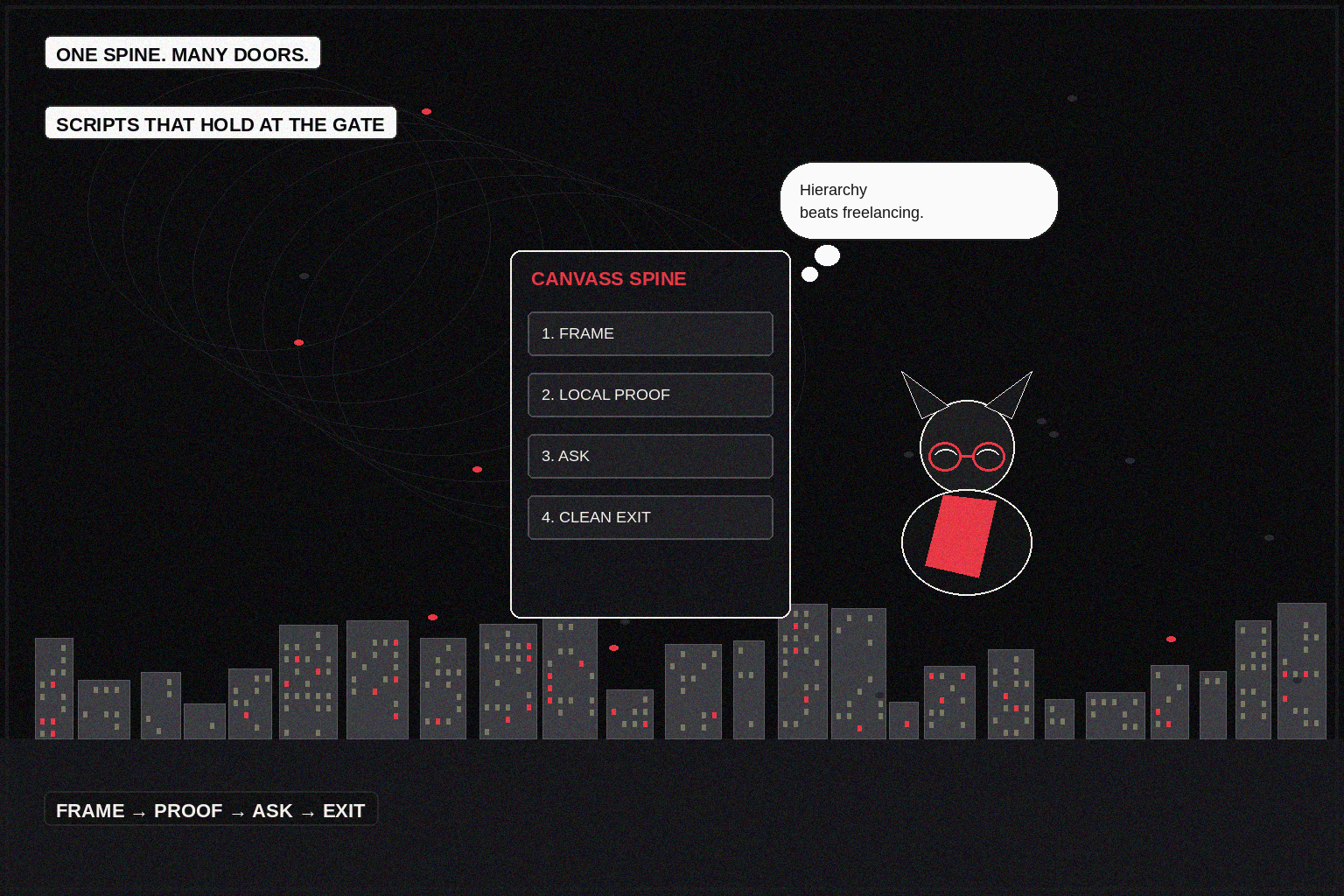
1. Frame — the one problem story your campaign owns this cycle. 2. Local proof — one fact, story, or validator that feels true on this street. 3. Behavioral ask — what you want before you leave the gate ( pledge, volunteer hour, share the Viber sticker pack, attend the assembly). 4. Clean exit — how you leave when the conversation turns hostile or circular.
Everything else is optional color. Color without hierarchy is noise.
Build the canvass kit like infrastructure, not inspiration
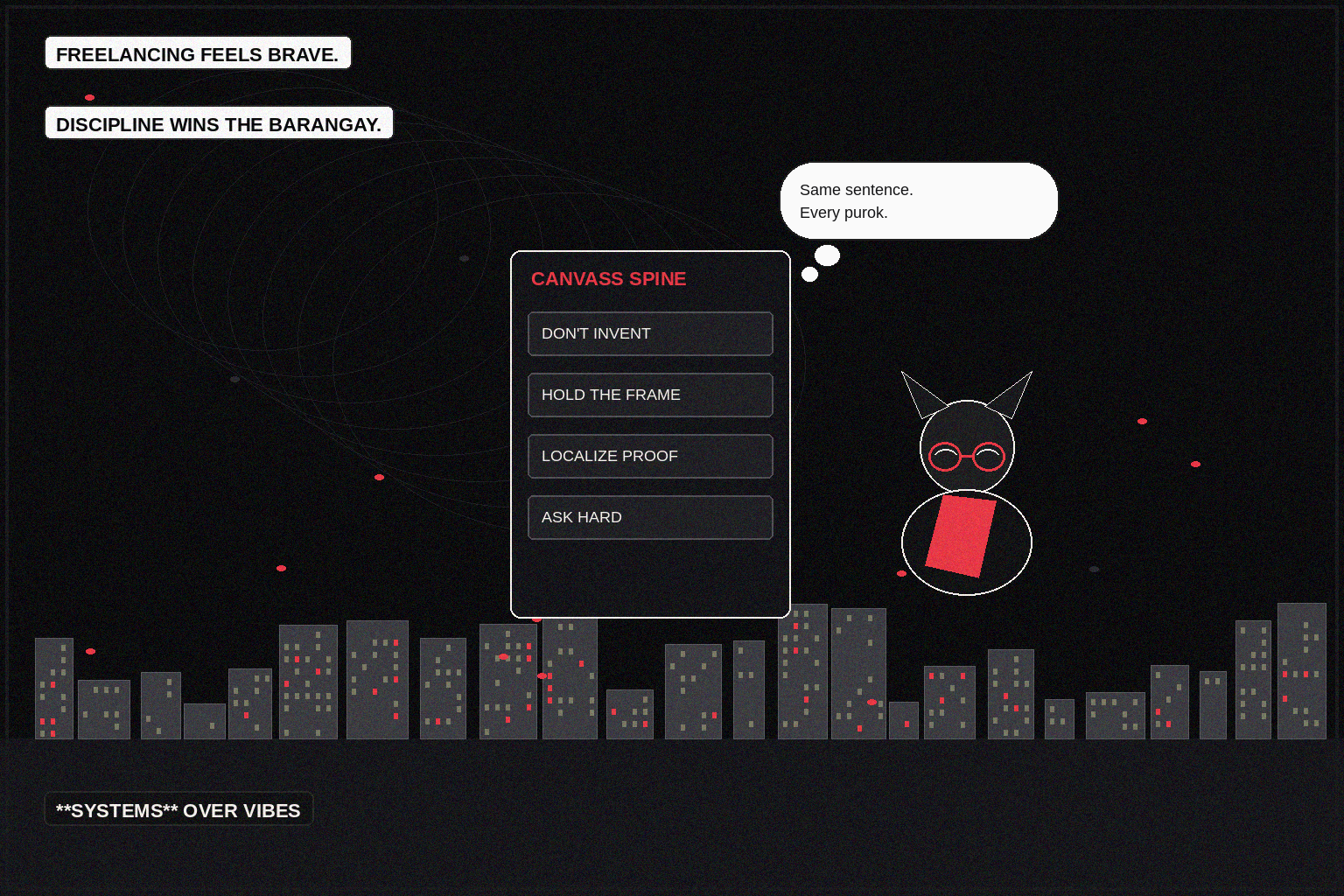
Most HQ teams over-invest in the launch video and under-invest in the card a nineteen-year-old can palm while sweating through a polo. Flip that ratio.
The one-page canvass spine
Print it. Laminate a few. Put it in the GC. Force every team lead to rehearse it out loud before Saturday.
- Opening bridge (8 seconds): name + purpose without biography dump.
- Frame sentence (12 seconds): problem → force that sustains it → why this candidate/issue now.
- Proof menu (choose one): personal story / local project beat / validator quote / contrast with status quo.
- Objection handles (three max): integrity, competence, “they’re all the same,” dynasty fatigue, “walang mangyayari.”
- Ask ladder: soft ask → concrete ask → stretch ask.
- Exit line: respectful close that leaves the door open for a second pass.
Notice what is missing: fifteen policy pillars, a QR forest, and a paragraph about “transformative leadership.” Those belong in decks. Doors need compression.
Vernacular is not a translation job—it is a hierarchy job
Tagalog, Cebuano, Ilocano, Hiligaynan, English—same spine, different mouthfeel. Bad campaigns translate slogans. Good campaigns rebuild density. A Cebuano frame that keeps the same villain and ask will outperform a perfect English rhyme that volunteers cannot say without laughing at themselves.
In diaspora-adjacent barangays and condo belts, code-switching is the native register. Train for it. Do not pretend one English line covers Makati and a coastal sitio.
Training that sticks after the first jeepney ride
Workshops that end with applause and no drills fail by Monday. Run pressure rehearsals:
- Hostile uncle who only wants to talk dynasty.
- Tired mother who has sixty seconds.
- Youth voter who only knows your candidate from a stitch.
- Party-list ally who wants to hijack the pitch for their issue.
- Rumor callback: “I saw on Facebook na…”
Score volunteers on hierarchy fidelity, not charm. Charm without frame loses to a disciplined opponent with worse merch.
Field leadership is message QA
Team leads are not only logistics. They are live editors. After each block:
- What language drifted?
- Which proof landed in this barangay?
- Which ask got real commitments vs polite nods?
- Did anyone freelance an attack line?
Capture it in a shared note the same afternoon. Paid media and speechwriting should read field drift weekly. If your digital desk invents a new frame while canvass still runs the old one, you are running two campaigns with one logo.
Digital and doorstep are one system—or they fight
Barangay canvass now happens inside a phone. Households fact-check you mid-conversation. Volunteers forward stickers, Reels, and Viber voice notes as “proof.” If organic creative and canvass scripts diverge, the voter experiences contradiction in real time.
Align on:
- Same contrast sheet for stage, feed, and door.
- Same three objection handles across rapid response and field.
- Same ask of the week so digital CTAs and doorstep asks reinforce, not compete.
- Rumor protocol: what volunteers may correct live vs what they must escalate to the war room.
This is also a paid media problem. If your Meta creative promises a different theory of the race than your canvass opener, you are paying to confuse persuadables. GEO and local SEO pages for “barangay issues” and candidate FAQs should match the doorstep spine so search does not invent a fourth campaign.
Ethics of discipline in progressive and public-interest work
Message discipline is not manipulation when the frame is true and the ask is real. It is respect for voters’ time and for volunteers’ risk. In advocacy canvass—health access, climate adaptation, anti-corruption, labor—the same hierarchy applies. Issue campaigns die when every organizer becomes a freelance philosopher at the gate.
Protect volunteers from being turned into attack dogs. If your research desk clears a contrast, script it. If it is not cleared, it is not field language. Brand poison often starts with a “harmless” doorstep jab that screenshots forever.
A weekly operating rhythm that keeps language alive
- Monday: lock frame + ask of the week with strategy, field, digital.
- Wednesday: 30-minute surrogate/volunteer refresh; kill two weak proofs; add one local proof.
- Saturday–Sunday: canvass; team leads log drift.
- Sunday night: 15-minute wash-up; update the one-pager before the next drop.
No three-day retreats required. Ruthless short cycles beat beautiful binders.
The doorstep is where your message system meets the country. Slogans bounce. Hierarchies hold. Volunteers with a spine can sound human and coherent—especially in Philippine barangay canvass, where trust is local, rumor is fast, and attention is scarce.
Neuwark Communications builds field-ready message systems for candidates, coalitions, and advocacy campaigns across the Philippines and APAC. If your canvass still depends on charismatic freelancing, start a conversation with us before the next precinct weekend writes your brand for you.
[Start a conversation →](https://neuwarkcommunications.com/contact)