Creative testing is supposed to make campaigns smarter. Too often it makes them softer. A progressive or public-interest team in Manila, Jakarta, or Taipei starts with a sharp frame—capture, neglect, a broken pipeline, a rights claim with teeth. Then the testing stack arrives. Thumbnails get friendlier. Hooks get vaguer. End cards smile harder. By week three the “winner” could sell a credit card. Click-through looks healthy. Belief looks sedated.
Neuwark Communications works where persuasion decides outcomes: candidates, issue campaigns, coalitions, institutions across the Philippines and wider APAC. We don’t decorate agendas. We engineer belief. And belief dies when A/B becomes a machine for removing everything that might offend a mid-funnel average. You can test without becoming a bank ad. You just have to decide what is sacred before the dashboard starts voting.
The real failure mode isn’t “no testing.” It’s testing the wrong layer
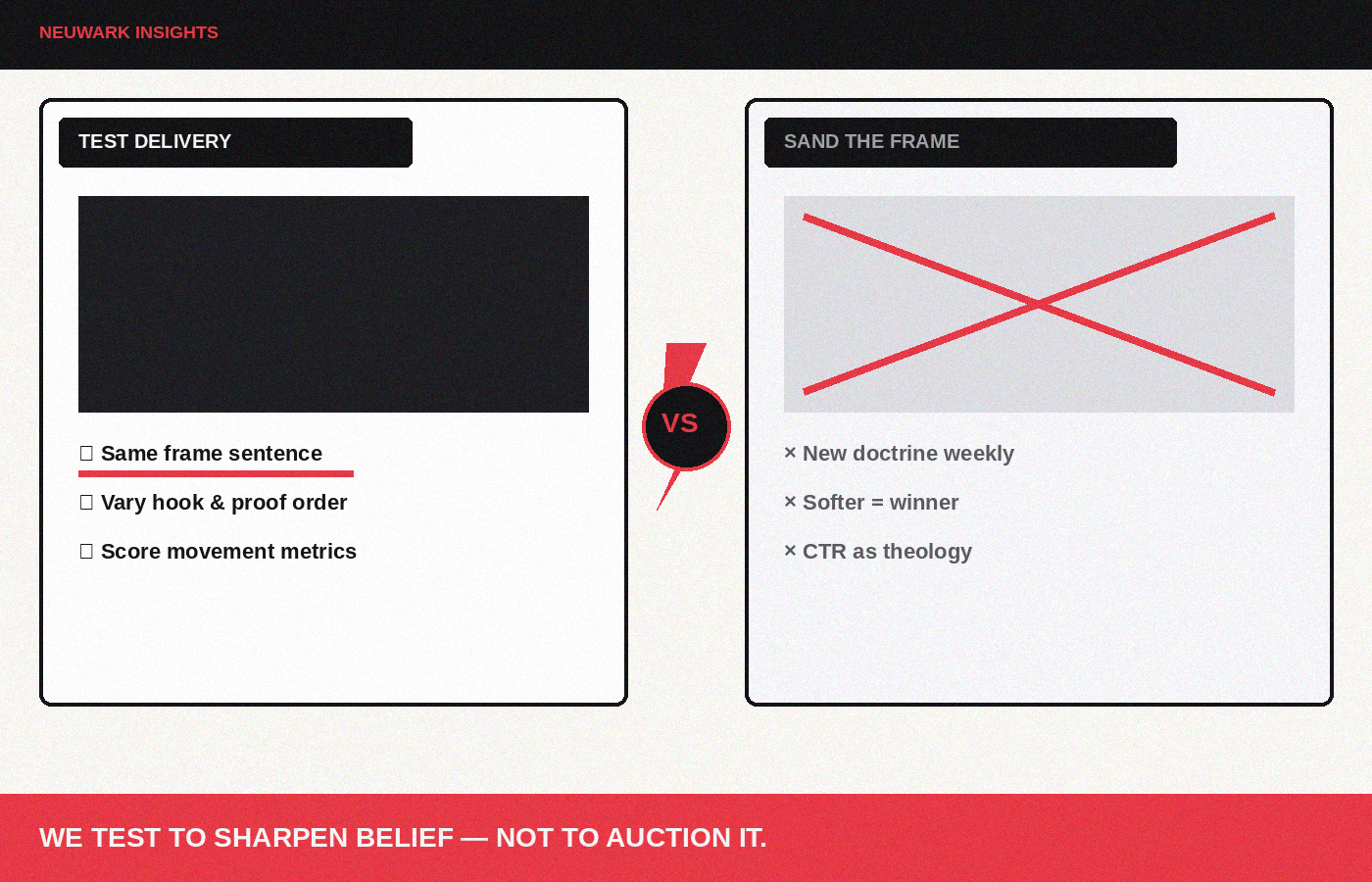
Most teams treat creative as a pile of interchangeable variables: color, face, first three seconds, CTA button, music bed. Platforms reward that worldview. So does every agency that bills hours against “optimization.” The problem is hierarchical. A message system has a frame, a proof stack, and a behavioral ask. Testing should mostly live in the bottom two layers and in delivery craft. When you A/B the frame itself every other day, you are not learning—you are erasing identity.
In Philippine and regional public life, audiences are fluent in sincerity theater. They have seen CSR spots, government explainers, influencer “heart” posts, and candidate lifestyle reels. Softness is not neutral. Softness often reads as elite distance or corporate cosplay. A test that systematically prefers low-friction comfort will select against moral clarity. That is not science. That is a preference laundering itself as data.
Operator rule: if your winning variant could run with another logo and still make sense, you did not find a winner—you found a rental aesthetic.
What you should protect before you open the lab
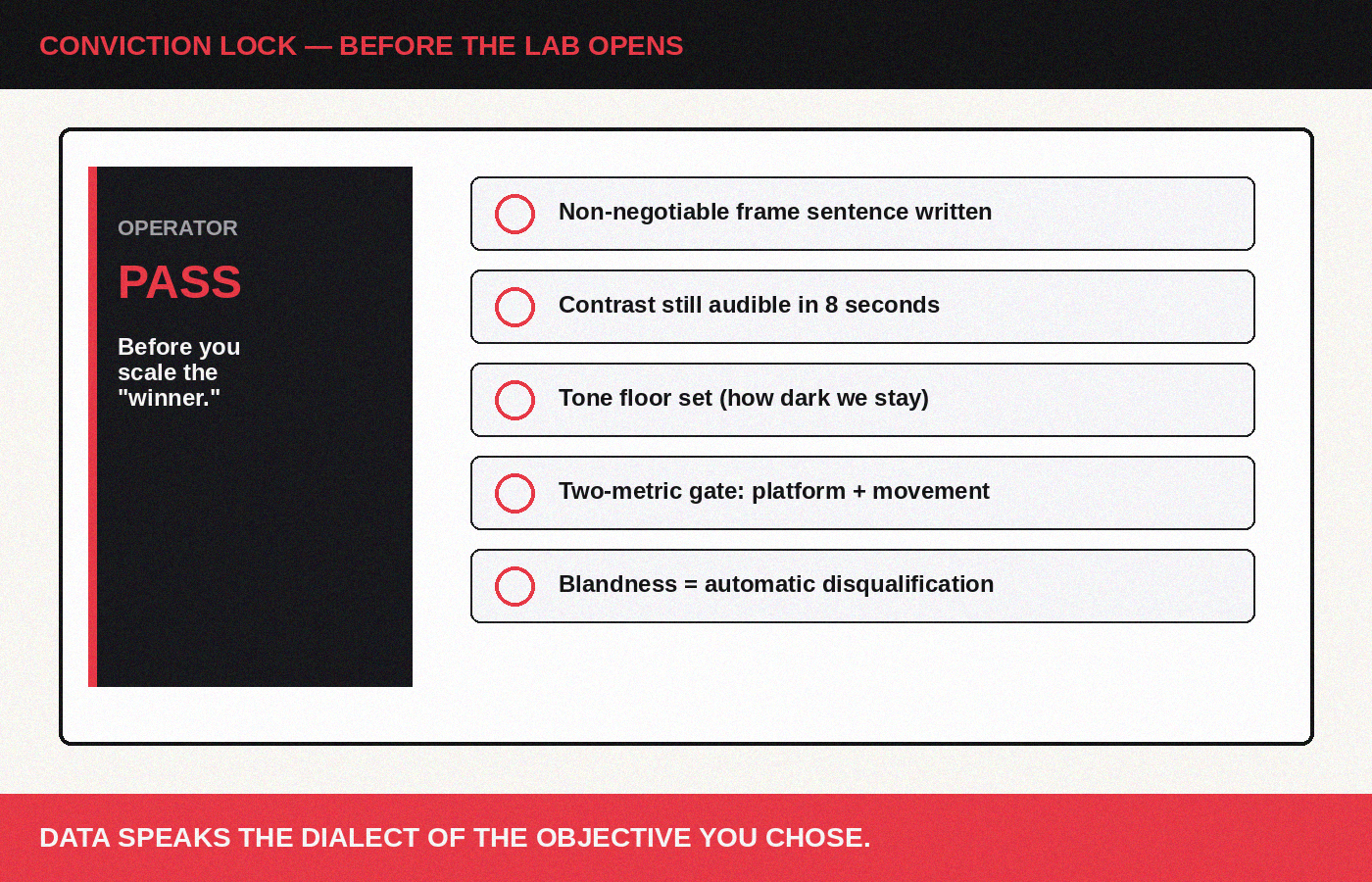
Write a one-page conviction lock before any creative test ships:
1. Non-negotiable frame sentence — the problem story you will not sand down for CTR. 2. Contrast that must remain audible — who benefits from the broken status quo; what you refuse to blur. 3. Tone floor — how dark, direct, or confrontational the work is allowed to stay. 4. Casting and place truth — communities and geographies you will not replace with generic “aspirational” faces. 5. Ask integrity — what action you are actually recruiting; no fake micro-asks that juice metrics and starve movement.
If a proposed test violates the lock, it is not a test. It is a quiet rebrand.
How bank-ad gravity pulls winning variants downhill
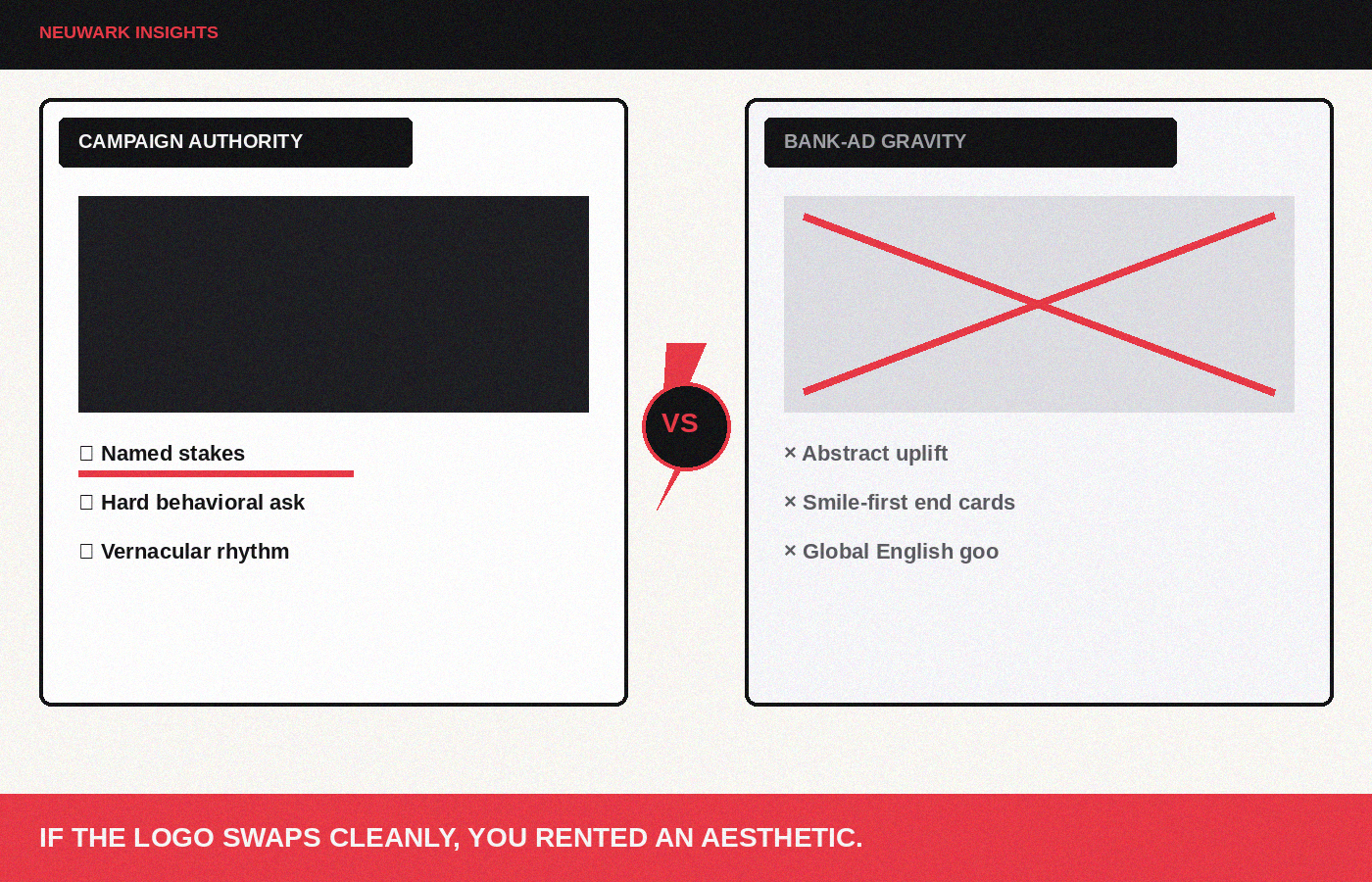
Bank and telco creative optimizes for reassurance, upward mobility, and frictionless belonging. Progressive and advocacy creative often needs the opposite: confrontation with a condition and agency to change it. Those goals select different winners.
Watch for these downhill patterns in PH/APAC paid and organic tests:
- Hook softening. Specific stakes (“the floodgate contract,” “the clinic with no oxygen”) lose to abstract uplift (“a better tomorrow”). Abstract wins early attention among friendlies and loses persuadability later.
- Face homogenization. Distinct community casting loses to polished “universal” faces that travel across markets and mean nothing in any of them.
- Score addiction. Sparse documentary sound loses to swelling hope anthems because completion metrics reward emotional sugar.
- Ask dilution. Hard asks (show up, call, volunteer, share a verified clip) lose to soft reacts because platforms price cheap engagement as success.
- Language flattening. Vernacular rhythm and bilingual honesty lose to English “global” cadence that feels imported in Cebu, Davao, or provincial group chats.
None of these patterns require a villain in the room. They emerge whenever the KPI is platform-native and the conviction lock is unwritten.
Redesign the test so conviction is a constraint, not a casualty
Treat testing like portfolio construction, not a beauty pageant.
Test delivery, not doctrine. Vary first-frame craft, proof order, caption density, thumbnail crop, end-card timing, vernacular register—while the frame sentence stays identical. You will learn how belief travels. You will not accidentally auction off your spine.
Score for downstream behavior, not only mid-funnel vanity. Pair platform metrics with owned outcomes: landing completion, volunteer form quality, donation honesty, event show-up, SMS confirmations, barangay captain shares, surrogate uptake. A Reel that “wins” CTR but produces confused volunteers is a loss with good lighting.
Run contrast holds. Keep a protected “sharp” control in every flight even if a softer cousin is cheaper per click. Track quality of conversation in comments and field feedback. Soft winners often recruit applause; sharp controls recruit workers.
Segment before you generalize. What wins among diaspora Facebook uncles may fail among Gen Z TikTok in Metro Manila. Do not crown a national aesthetic from one pocket of cheap reach.
Pre-commit kill criteria for blandness. If a variant strips named places, named mechanisms, or audible contrast, disqualify it regardless of CTR. Make blandness a policy violation, not a taste debate.
A field kit for creative tests that still feel alive
Give strategy, creative, and media the same Monday-morning artifacts:
- A conviction lock signed by campaign lead—not buried in a Notion graveyard.
- A variable map listing what may be tested this week (hook image, proof clip, CTA wording) and what may not (frame, villain theory, moral temperature).
- A quality scorecard reviewers use before launch: specificity, place truth, contrast audible in eight seconds, ask is behavioral, muted viewing still works.
- A two-metric gate: one platform metric and one movement metric. Both must clear—or the “winner” does not scale.
- A post-test narrative ritual: 15 minutes where the team says out loud what the data tempted them to abandon, and whether they refused.
In coalition work across APAC, share the lock with partners. Local producers can remix proofs and vernacular without reinventing the moral claim. That is how you scale without frankensteining your public face into a generic progressive stock kit.
What “human” testing sounds like in the room
Refuse the superstition that data speaks and people should shut up. Data speaks in the dialect of the objective you chose. Choose badly and you will get eloquent nonsense. The human move is to keep organizers, field leads, and community validators in the review loop—especially in the Philippines, where trust networks outperform dashboards. If a barangay coordinator says the winning ad feels like a bank CSR spot, believe them faster than you believe a 1.2% CTR lift.
Creative testing should make conviction travel better, not make conviction smaller. Grain, hard light, named stakes, vernacular honesty—these are not anti-data. They are the conditions under which progressive authority remains recognizable after the algorithm finishes chewing.
If you are building political, advocacy, or public-interest campaigns in the Philippines or across APAC and your tests keep sanding you into someone else’s reassurance machine, start a conversation with Neuwark Communications. We design creative systems and testing guardrails that sharpen belief instead of auctioning it off for cheap attention.
[Start a conversation →](https://neuwarkcommunications.com/contact)