
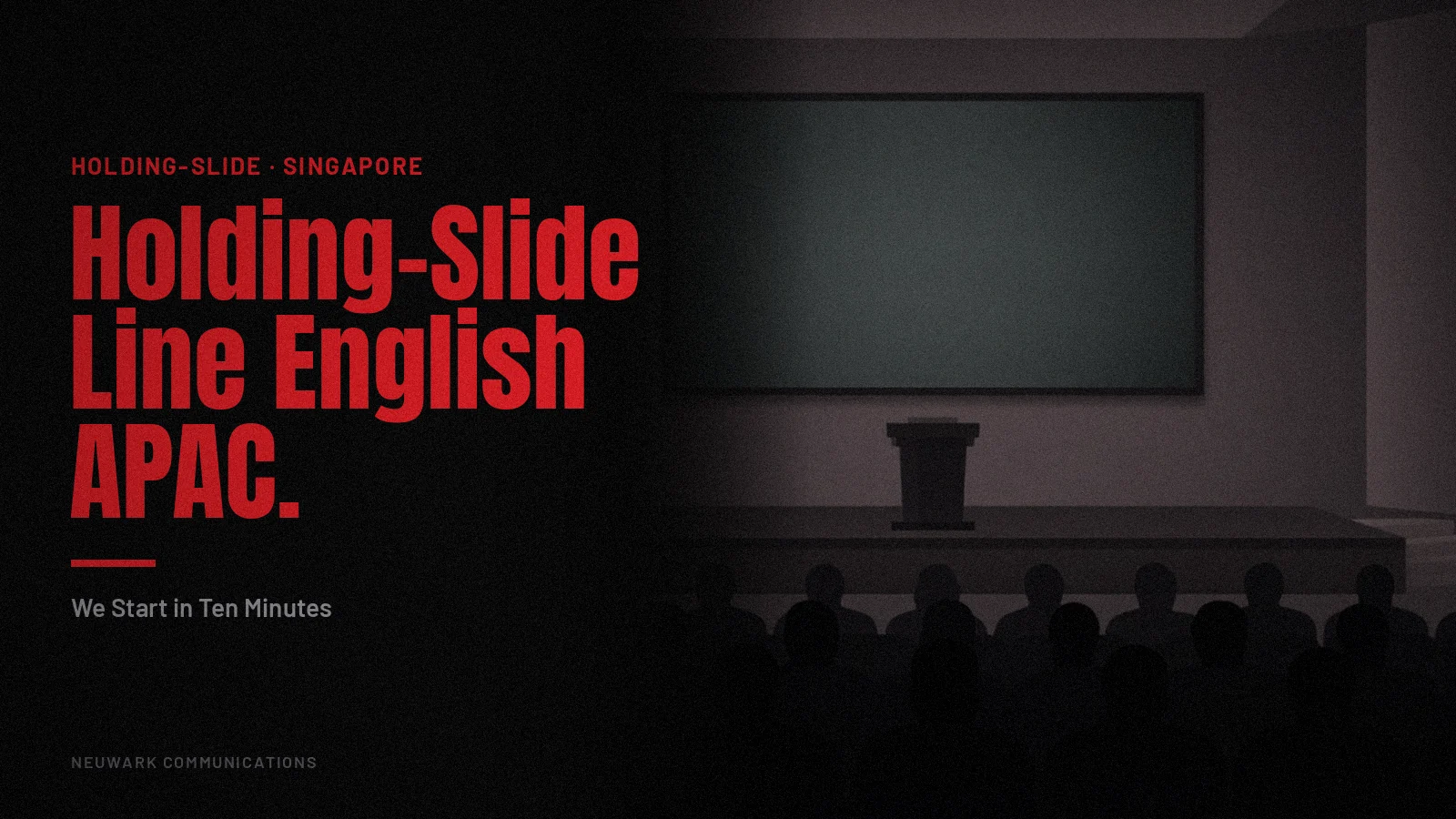
A Singapore conference hall, nine-fifty. The screen shows a sponsor reel on loop, the emcee says “we’ll start shortly,” and nobody knows if shortly means five minutes or thirty.
Holding-slide line English APAC is the short text on the holding slide and the matching emcee line: welcome, start time, one thing to do now.
Street-smart APAC English: short sentences a tired operator can say out loud.
It runs before the first cue in our time check cue English APAC world, while backstage our green room call English APAC brings the first speaker to the wings.
Quick answer: A holding-slide line English APAC is the text on the screen before a programme starts, plus the emcee line that matches it: welcome, the real start time, and one thing to do now. Keep the slide and the voice in the same words, and change the slide the moment the time changes.
What goes in a holding-slide line English APAC?
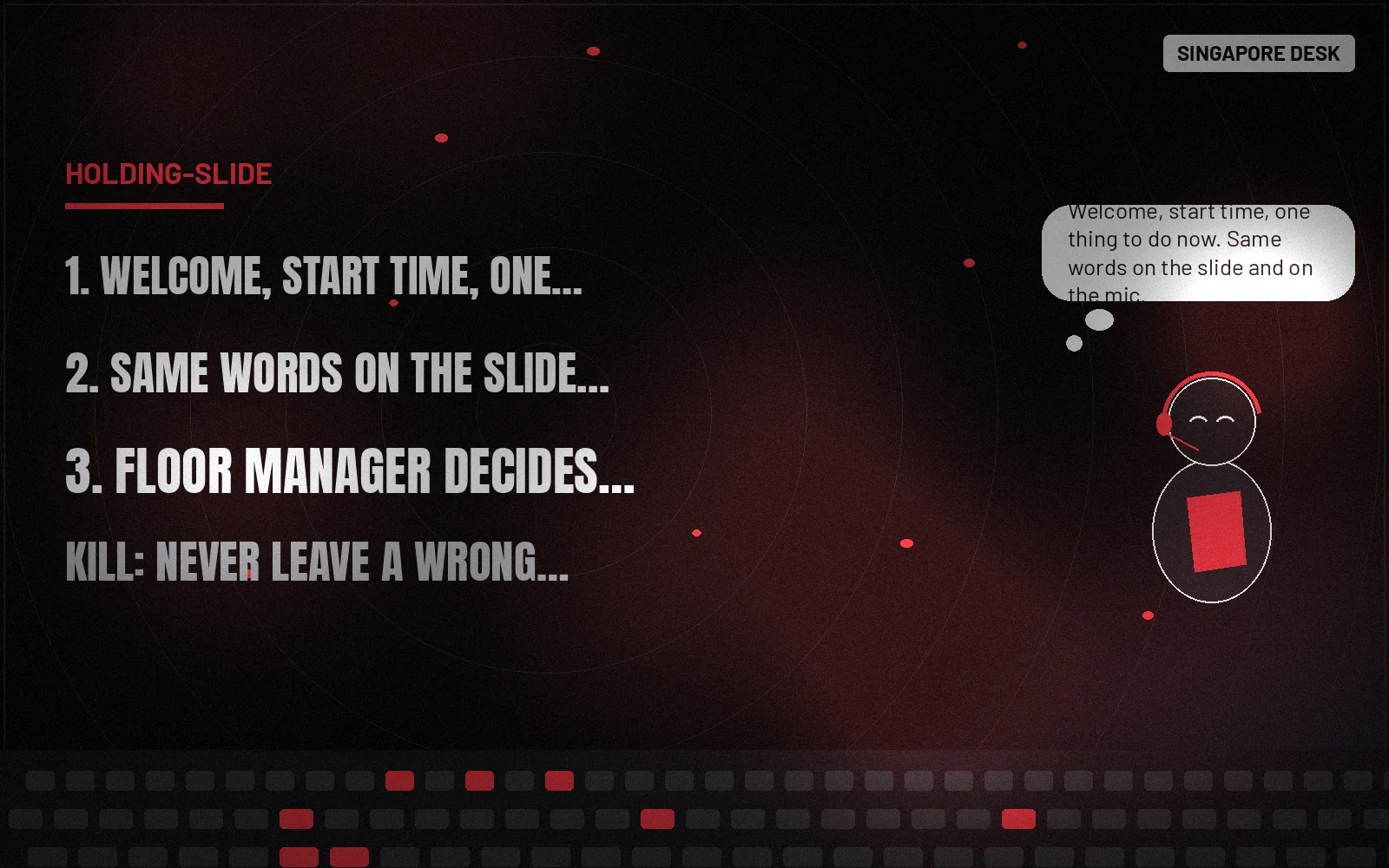
Three parts. Welcome, start time, one thing to do now.
Holding slide and emcee line (illustrative):
Slide: “Welcome. We start at 10:00. Please take your seat and put your phone on silent.”
Emcee: “Good morning and welcome. We start in ten minutes, at 10:00.”
Emcee: “Please take your seat. Phones on silent, thank you.”
Same words on the slide and on the mic. When they match, the room trusts both.
What should a holding slide say before an event starts?
A welcome, a real start time, and one thing to do now. Use a clock time, not “shortly”. Keep it short enough to read from the back row. Plain event language beats clever copy. If there is wifi or a hashtag the organiser wants shared, put it on a second slide, not this one.
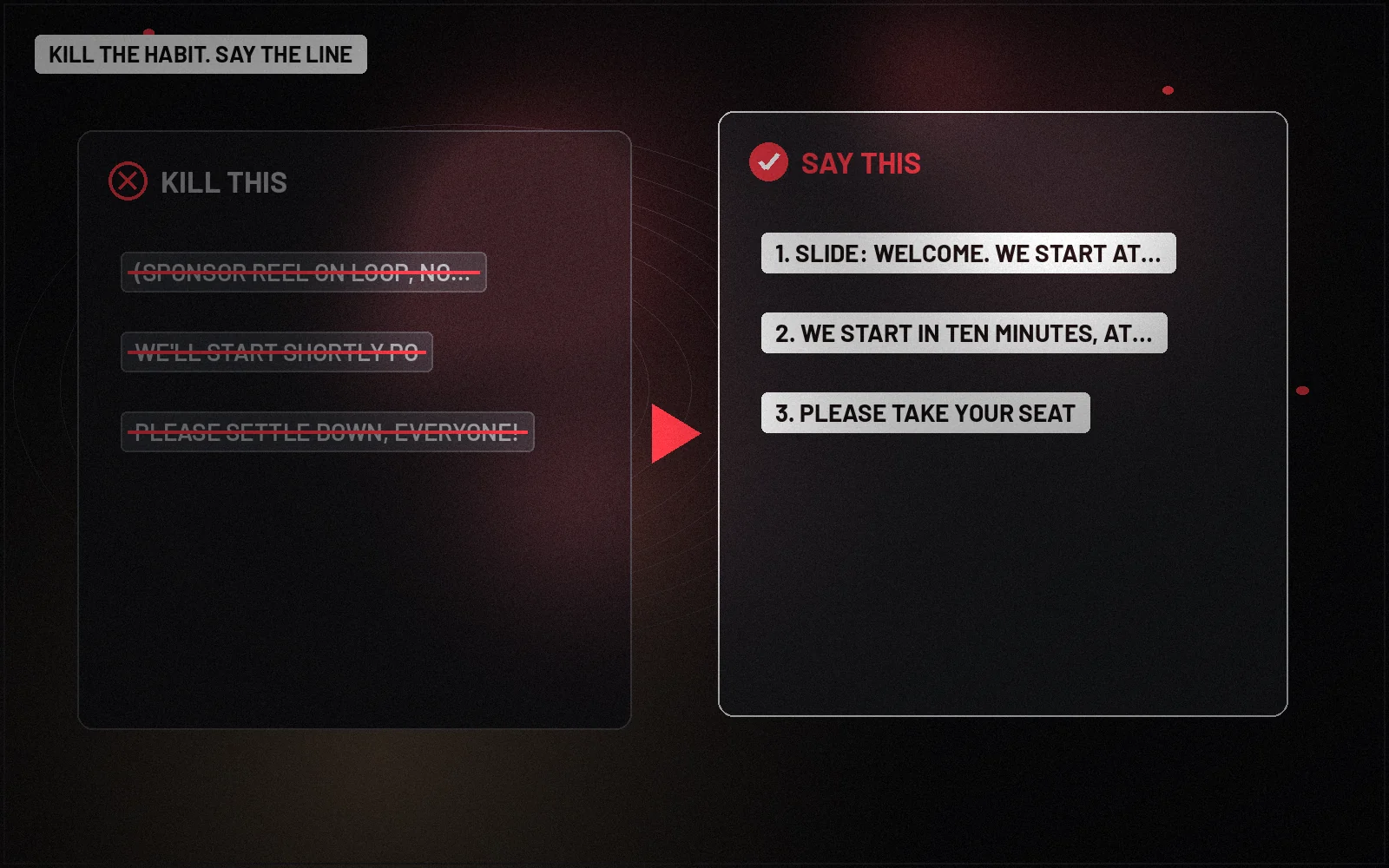
| Kill this | Say this (illustrative) | Why |
|---|---|---|
| (sponsor reel on loop, no time) | Slide: Welcome. We start at 10:00. | A real time |
| We’ll start shortly po. | We start in ten minutes, at 10:00. | Minutes and a clock time |
| Please settle down, everyone! | Please take your seat. | A simple action |
| (slide still says 10:00 at 10:20) | (slide updated to the new time) | Screen stays true |
| (emcee reads a different time from the slide) | (emcee reads the slide’s exact words) | Voice and screen agree |
Who changes the holding slide if the start is delayed?
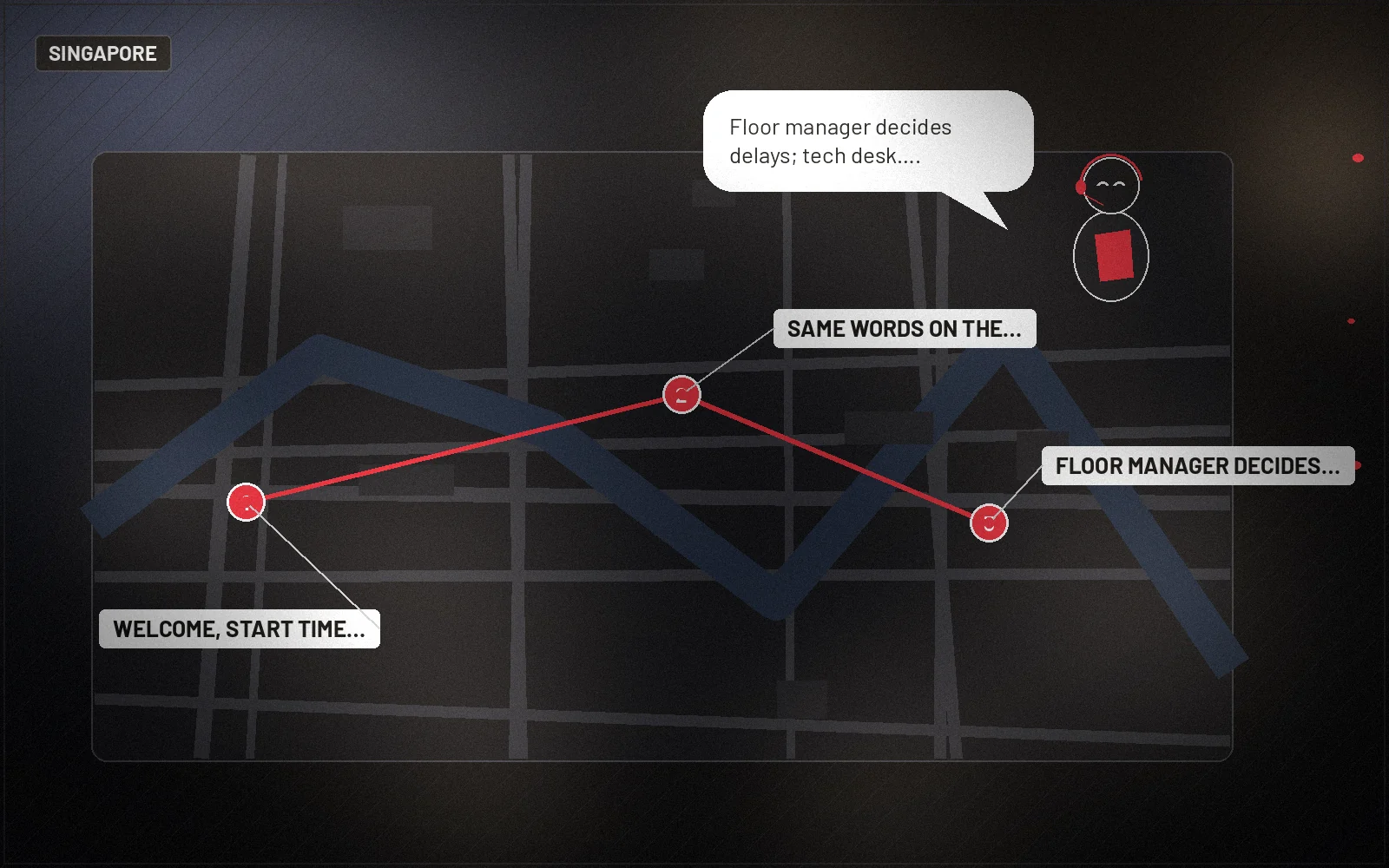
The tech desk, on the floor manager’s call. The floor manager decides the new time, the tech desk changes the slide, and the emcee says the new time once. Agree this chain at the tech run so nobody improvises.
How often should the emcee repeat the holding line?
At ten minutes, at five minutes, and at the start. Three times is enough. More than that, and the room tunes out.
How does this play out in PH and SG?
Same three parts. Different halls.
Philippines desk. At Philippine events, guests may keep arriving long after the posted time, and officials may arrive late. Keep the slide honest about the new time, say it in English or Filipino, and never leave an old time on screen.
Singapore and wider APAC desk. At Singapore conferences, guests often expect a punctual start and a clear holding slide. Keep the text in plain English, show a clock time, and start on that time if you can.
Paste-ready lock
Speakable lock (illustrative): “Good morning and welcome, we start in ten minutes at 10:00, so please take your seat and put your phone on silent.”
Monday field kit
- Welcome, start time, one thing to do now.
- Same words on the slide and on the mic.
- Floor manager decides delays; tech desk changes the slide.
- Emcee repeats at ten, five and zero minutes.
- Kill rule: never leave a wrong start time on the screen.
What to do this week
- Write the holding slide with a clock time.
- Write the matching emcee lines.
- Agree the delay chain at the tech run.
- Prepare a spare slide with the time left blank.
FAQs
What is a holding-slide line English APAC?
A holding-slide line English APAC is the short text on the holding slide and the matching emcee line: welcome, start time, one thing to do now. The slide and the voice use the same words.
What should a holding slide say?
A holding slide should say welcome, the real start time and one thing to do now. Use a clock time rather than shortly.
Who changes the holding slide during a delay?
The tech desk changes the holding slide during a delay, on the floor manager’s call. The emcee then says the new time once.
How often should the emcee repeat the start time?
The emcee should repeat the start time at ten minutes, five minutes and the start. Three times is enough for most rooms.
Neuwark Communications builds event and campaign communications as part of our public affairs and crisis and rapid response work. More street-smart lines live in Insights.
Related: Time check cue English APAC · Green room call English APAC
Talk to us about your next event script.
Illustrative lines only. Communications craft, not legal advice.