

Two days before a gala dinner in Ortigas. The caterer asks for final meal counts. The team scrolls through three Viber groups, a spreadsheet and forty “noted po” replies.
Nobody can say which guests asked for a vegetarian meal.
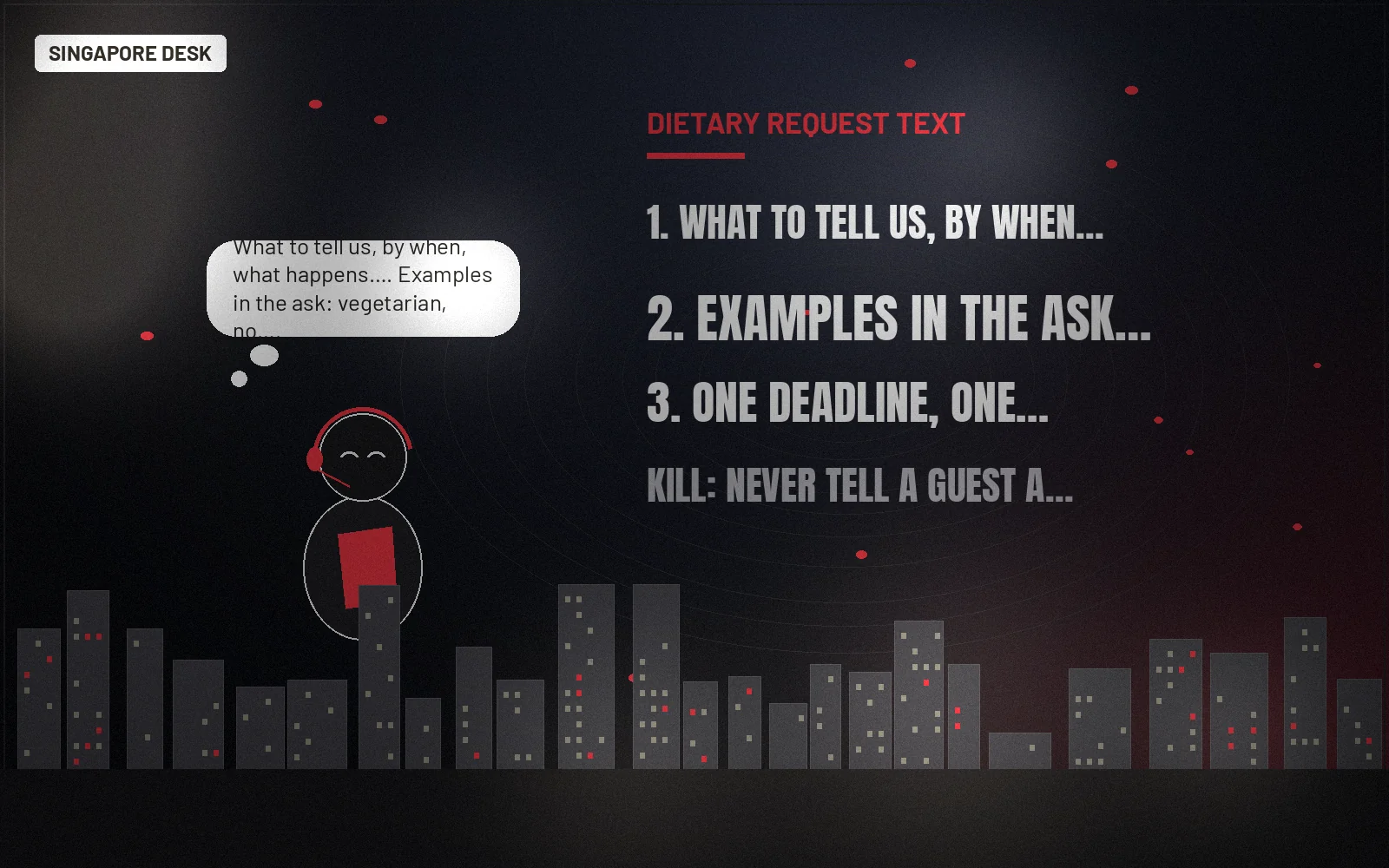
Dietary request text English APAC is the short message that collects meal needs: what to tell us, by when, and what happens next.
Street-smart APAC English: short sentences a tired operator can say out loud.
It rides alongside our briefing RSVP confirm English APAC, which locks the seat. Like our registration cutoff text English APAC, it lives or dies by a clear deadline.
Quick answer: A dietary request text English APAC asks each guest one clear question about meal needs, gives a deadline, and says what happens next. Collect replies in one place, pass every request to the caterer or venue to confirm, then reply to each guest so they know their meal request was received and passed on.
What goes in a dietary request text English APAC?
Three parts. What to tell us, by when, what happens next.
Dietary request text (illustrative):
“Hi, it’s the events team for Thursday’s dinner. Do you have a meal request, such as vegetarian, no pork or an allergy?”
“Please reply by Friday, 5 PM.”
“We will pass your request to the caterer and confirm back to you.”
Ask once, clearly, with examples. “Any dietary restrictions?” on its own gets “none po” from people who do have a request.
Why give a deadline?
Because the caterer needs final numbers, and requests that arrive on the night cannot always be met. A day and a time is clear: “Reply by Friday, 5 PM.” Put the deadline in the first message and repeat it in one reminder.
After the deadline, say what happens: “After Friday, we will do our best, but we cannot promise a special meal.”
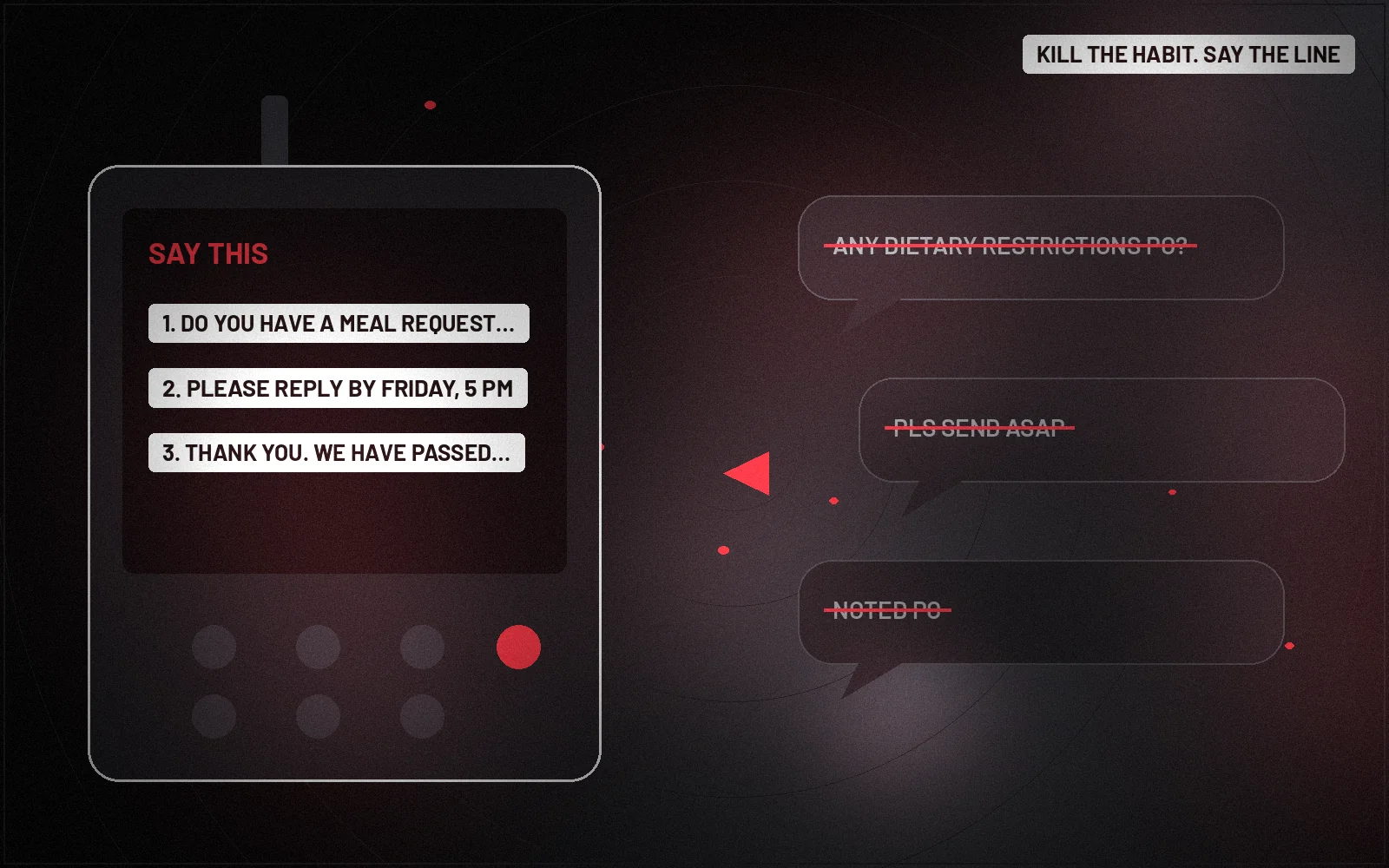
| Kill this | Say this (illustrative) | Why |
|---|---|---|
| Any dietary restrictions po? | Do you have a meal request, such as vegetarian, no pork or an allergy? | Examples get real answers |
| Pls send ASAP. | Please reply by Friday, 5 PM. | A deadline people can keep |
| Noted po. | Thank you. We have passed your vegetarian request to the caterer. | Confirms the exact request |
| Our food is safe for everyone. | Please tell us about any allergy. We will pass it to the caterer to check. | No promises we cannot make |
| Halal po lahat. | Thank you. We have passed your halal meal request to the caterer. | A request, not a claim |
How should you reply to a meal request?
Confirm the exact request back, and say it has gone to the caterer: “Thank you. We have passed your vegetarian request to the caterer. Your name will be on a meal card at your seat.” This tells the guest you heard them correctly.
Do not promise more than you control. The events team passes requests on. The caterer or venue confirms what they can prepare.
What about allergies?
Treat any allergy as something the caterer or venue must confirm directly. Your text collects it and passes it on: “Thank you for telling us. We have passed this to the caterer, and they will confirm with us.” Do not tell the guest a dish is safe. Do not guess what is in the food. If the caterer needs more detail, put them in touch, or ask the question word for word.
On the night, tell the guest who to ask: “Please speak to the banquet captain at your table.”
What about halal and other faith-based meal requests?
Record them as guest requests, in the guest’s own words, and pass them to the caterer. The events team does not make claims about how food is prepared or certified. If a guest asks, the honest line is: “We have passed your request to the caterer. They will confirm what they can provide, and we will tell you.”
How does this play out in PH and SG?
Same three parts. Different chats.
Philippines desk. In the Philippines, the text will likely go by Viber, with replies in Taglish and the occasional voice note. Ask guests to reply in one message, and send each confirmation as a direct message, not in the group, so meal requests stay private.
Singapore and wider APAC desk. In Singapore, WhatsApp or the RSVP form is usual, and halal, vegetarian and no-beef requests are common at mixed dinners. Ask about them plainly, in plain English, and pass every request to the caterer or venue to confirm.
Paste-ready lock
Speakable lock (illustrative): “Do you have a meal request, please reply by Friday, 5 PM, and we will pass it to the caterer and confirm back to you.”
Monday field kit
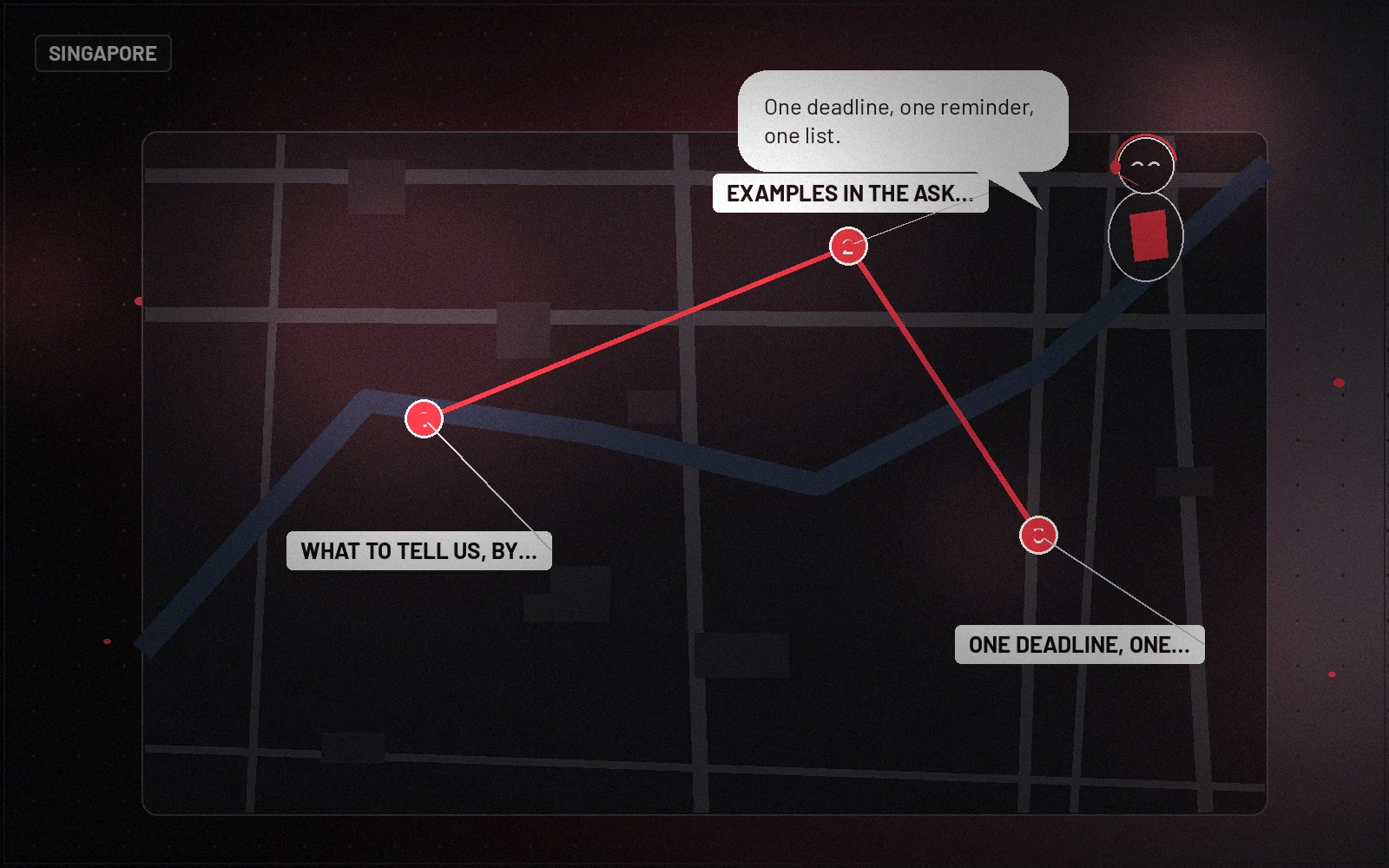
- What to tell us, by when, what happens next.
- Examples in the ask: vegetarian, no pork, an allergy.
- One deadline, one reminder, one list.
- Confirm the exact request back to each guest, privately.
- Kill rule: never tell a guest a dish is safe or certified; the caterer or venue confirms.
What to do this week
- Write the request text and the confirmation reply.
- Agree the deadline with the caterer.
- Set up one list for all meal requests.
- Ask the venue how meal cards and the banquet captain will work.
FAQs
What is a dietary request text English APAC?
It is the short message that collects meal needs: what to tell us, by when, and what happens next. It ends with a confirmation back to each guest.
How do you ask guests about dietary needs?
Ask one clear question with examples, such as vegetarian, no pork or an allergy. Give a day and a time to reply by.
Who confirms allergy and halal requests?
The caterer or venue does, because they prepare the food. The events team collects each request and passes it on in the guest’s own words.
Neuwark Communications plans event and field messaging as part of our services, including Digital and Social for invite flows, RSVP texts and guest messaging. Meal requests lost across three chat groups? Talk to us at Contact. More language companions live in Insights.
Illustrative lines only. Communications craft, not legal advice; counsel checks election-period and platform rules.
Related: Briefing RSVP confirm English APAC · Registration cutoff text English APAC