
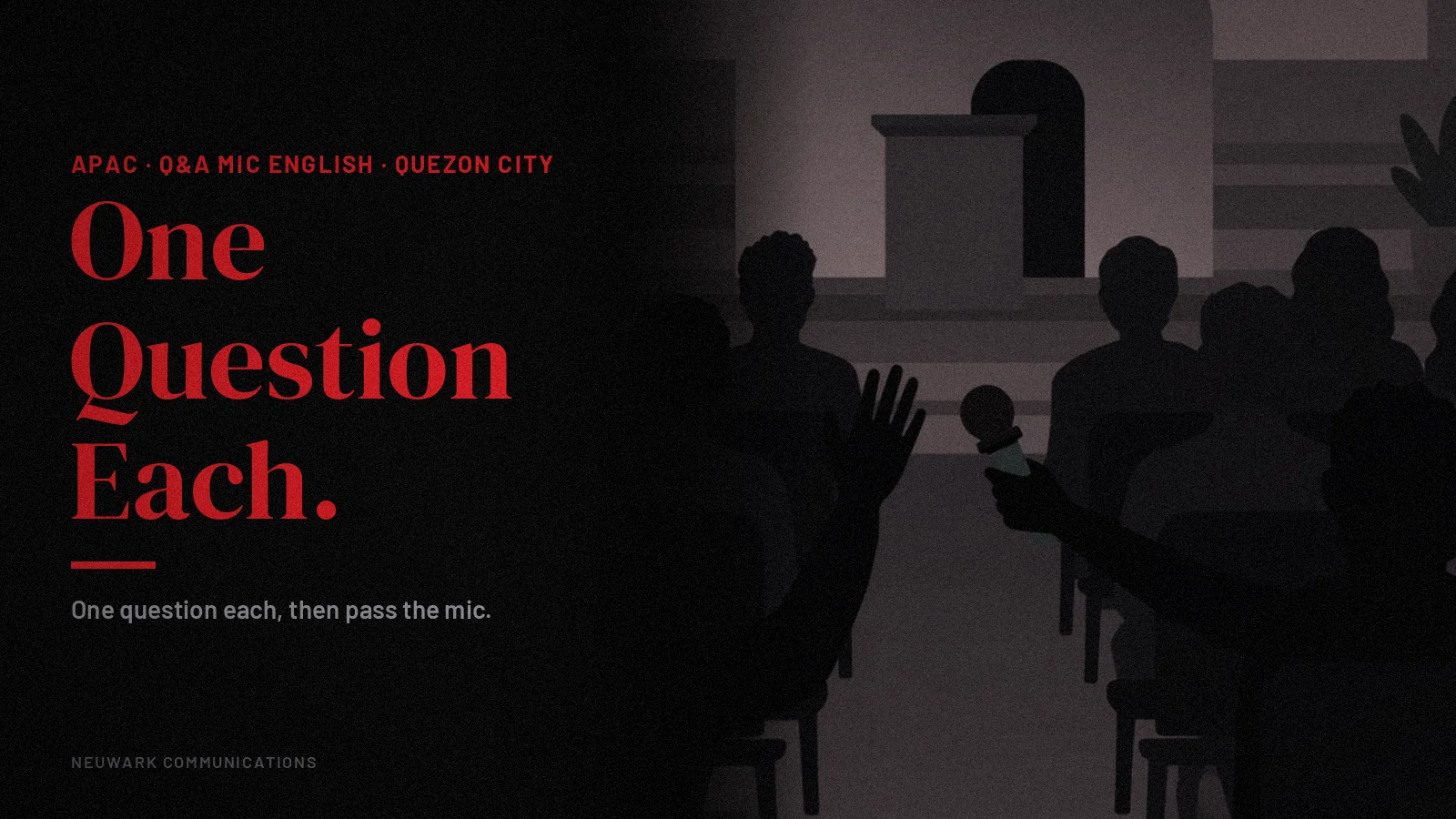
A town hall in a Quezon City covered court. The first person handed the mic stands up, thanks everyone, gives a four-minute speech and asks three questions.
Twenty hands go down. Half of them never come back up.
Q&A mic line English APAC is the short line that runs the audience mic: one question each, keep it short, then pass the mic.
Street-smart APAC English: short sentences a tired operator can say out loud.
It follows on from our town hall ground rules English APAC, which set the rules at the start. When a speaker runs long on stage instead, our time check cue English APAC handles the front of the room.
Quick answer: A Q&A mic line English APAC is the moderator’s short rule for the audience mic: one question per person, kept short, then the mic moves on. Say it before the first hand goes up, repeat it when the mic changes hands, and give mic runners the same words so the rule sounds the same in every aisle.
What goes in a Q&A mic line English APAC?
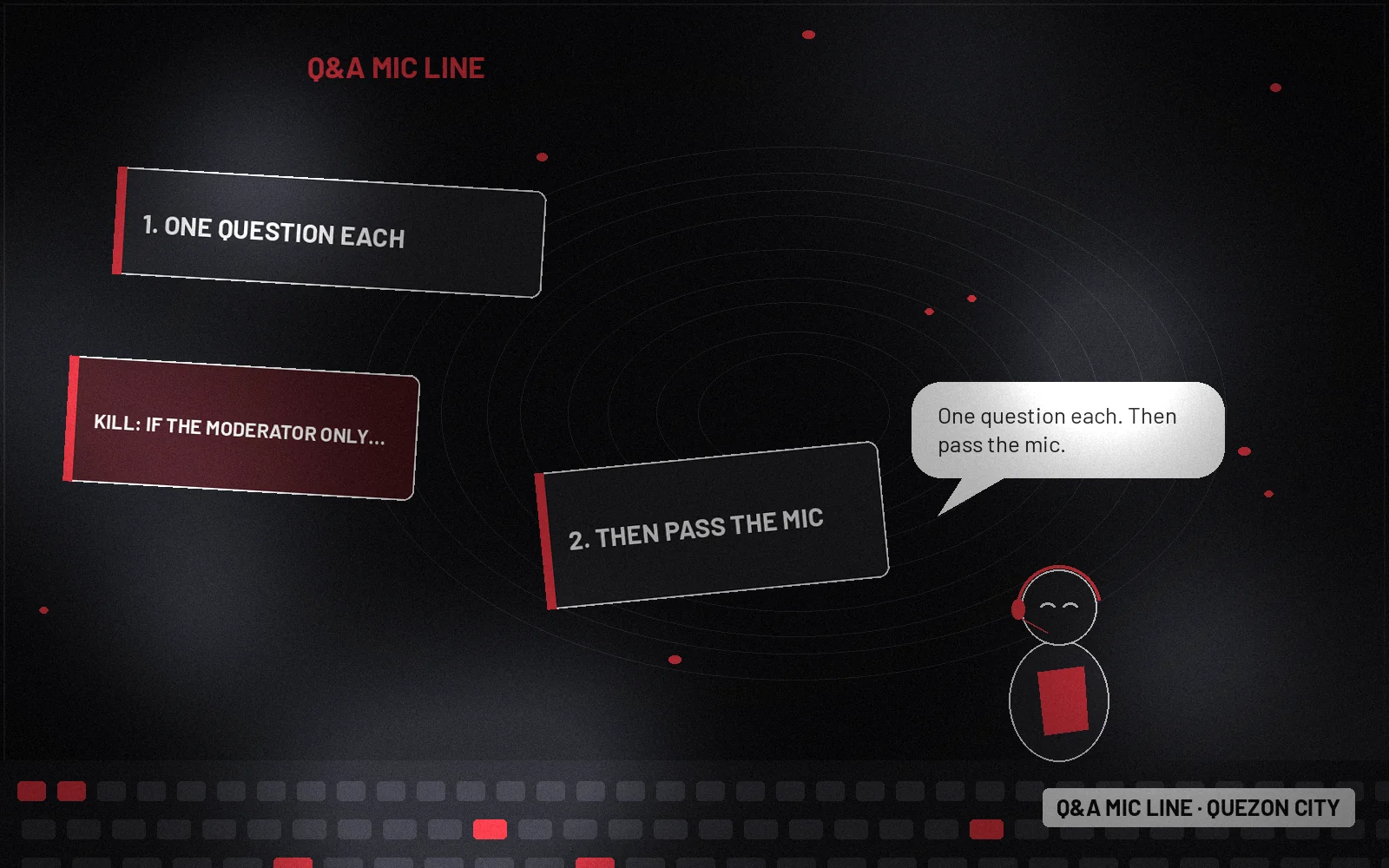
Three parts. One question each, keep it short, then the mic moves on.
Q&A mic line (illustrative):
“We have time for questions now. One question each, please.”
“Keep it short so more people get a turn.”
“When you are done, hand the mic back to the runner.”
Say it before the first hand goes up. A rule announced after the first long speech sounds like a complaint about that person.
Why one question each?
Because the mic is the scarcest thing in the room. One person with three questions takes three turns from three other people. One question each is fair, it is easy to say, and nobody has to judge whether a question is “too long” in the moment.
It also helps the panel. One question gets one clear answer, instead of a list the speaker half-remembers.
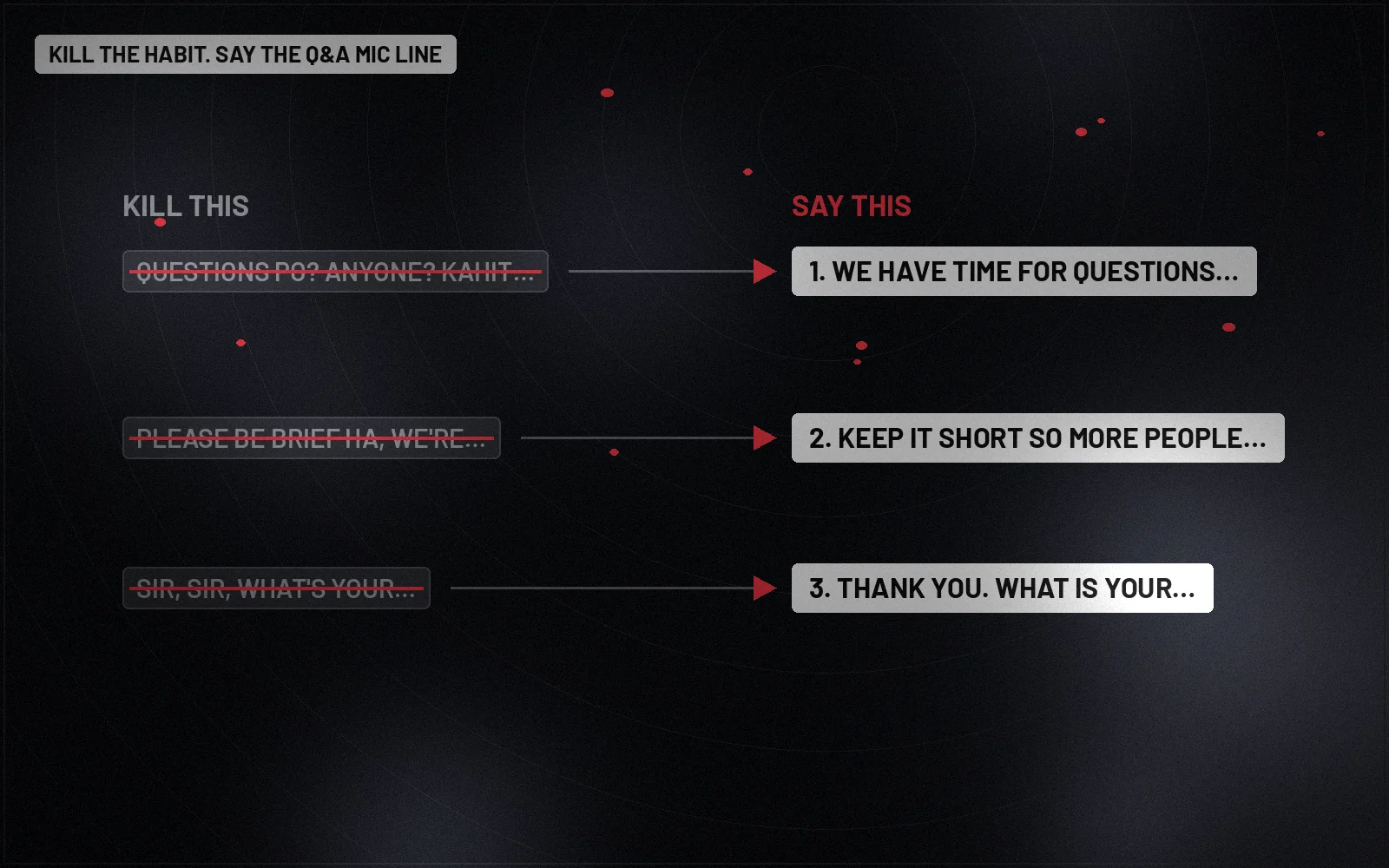
| Kill this | Say this (illustrative) | Why |
|---|---|---|
| Questions po? Anyone? Kahit ano. | We have time for questions now. One question each, please. | The rule before the first hand |
| Please be brief ha, we’re running late. | Keep it short so more people get a turn. | A reason that is about them |
| Sir, sir, what’s your question? | Thank you. What is your question for the panel? | Steers without a scolding |
| Last na po talaga. | We have time for two more questions. | An honest count |
| (grabbing the mic back) | Thank you. The mic is going to the back row now. | Moves the mic, keeps face |
How do you stop a speech at the mic?
Wait for a breath, thank them, and ask for the question: “Thank you. What is your question for the panel?” Say it warmly and once. Most people take the cue.
If they keep going, the moderator says, “Let’s hear the question, so we can get to the next person.” No sarcasm, no sighing into the mic. The room is watching how you treat the person holding it.
What do mic runners say in the aisle?
The same rule, quietly, as they hand over the mic: “One question, please. I’ll take the mic back after.” Runners hold the mic out, not up, so it is clear it is coming back. Give runners a route, front to back or one side then the other, so the room can see the mic moving fairly.
If you also take written cards or online questions, the moderator reads them out in turn. Say so at the start, so people who do not want the mic still have a way in.
What if there is no time for every question?
Say so early, not at the end: “We have time for about five more questions.” Then keep the count honest. When time is up, say where the rest go: “If we did not get to you, please write your question on a card at the help desk. We will reply by email.” Only promise replies you will actually send.
How does this play out in PH and SG?
Same three parts. Different rooms.
Philippines desk. At a barangay hall or covered court town hall, people may stand to greet officials and elders first, at length. Allow one short greeting, then the question, and say it kindly: “One greeting and one question, please.” Repeat the line in Filipino if the room needs it, and send the format in the Viber or WhatsApp invite.
Singapore and wider APAC desk. At a Suntec or Marina Bay forum, the audience may be quieter and slower to raise hands. Seed the first question from a card, then invite the mic, and keep the rule in plain English for guests working in a second language.
Paste-ready lock
Speakable lock (illustrative): “One question each, please, keep it short so more people get a turn, and then hand the mic back to the runner.”
Monday field kit
- One question each, keep it short, pass the mic. Said before the first hand.
- Mic runners say the same words in the aisle.
- A route for the mic, so the room sees it move fairly.
- Cards or online questions read out in turn.
- Kill rule: if the moderator only states the rule after a long speech, it sounds like a scolding; say it first.
What to do this week
- Write the three lines into the moderator’s script.
- Brief the mic runners on the line and the route.
- Print question cards and set a box at the help desk.
- Decide how many questions the time allows.
FAQs
What is a Q&A mic line English APAC?
It is the short line that runs the audience mic: one question each, keep it short, then pass the mic. The moderator says it before the first hand goes up.
How do you politely stop someone making a speech during Q&A?
Wait for a breath, thank them, and ask for their question for the panel. If they keep going, say you want to hear the question so the next person gets a turn.
How many questions should a town hall take?
As many as the time honestly allows, and say the number early. When time runs out, tell people where to leave the questions you could not take.
Neuwark Communications plans event and field messaging as part of our services, including Strategy and Messaging for town hall formats and moderator scripts. Q&A that keeps turning into speeches? Talk to us at Contact. More language companions live in Insights.
Illustrative lines only. Communications craft, not legal advice; counsel checks election-period and platform rules.
Related: Town hall ground rules English APAC · Time check cue English APAC