
Something happened at the covered court around eight. Maybe half past. Someone shouted, someone filmed, a chair went over.
By morning there are four versions in the group chat, two blurry videos and no record anyone would sign. A reporter calls. Nobody can say what actually happened.
Incident log English APAC is the running record where each thing that happened gets one line: time, place, what was seen, who logged it and what was done.
Street-smart APAC English: short sentences a tired operator can say out loud.
It is the event-night cousin of our canvass debrief English APAC. If a public statement later needs fixing, the log is what a correction note English APAC leans on.
What goes in an incident log English APAC line?
Five fields, one line. Time, place, what was seen, who logged it, what was done.
Incident log line (illustrative):
“20:12 · Covered court, east gate · Two attendees arguing loudly, one chair knocked over · Logged by Jo · Floor manager separated them, no injuries seen.”
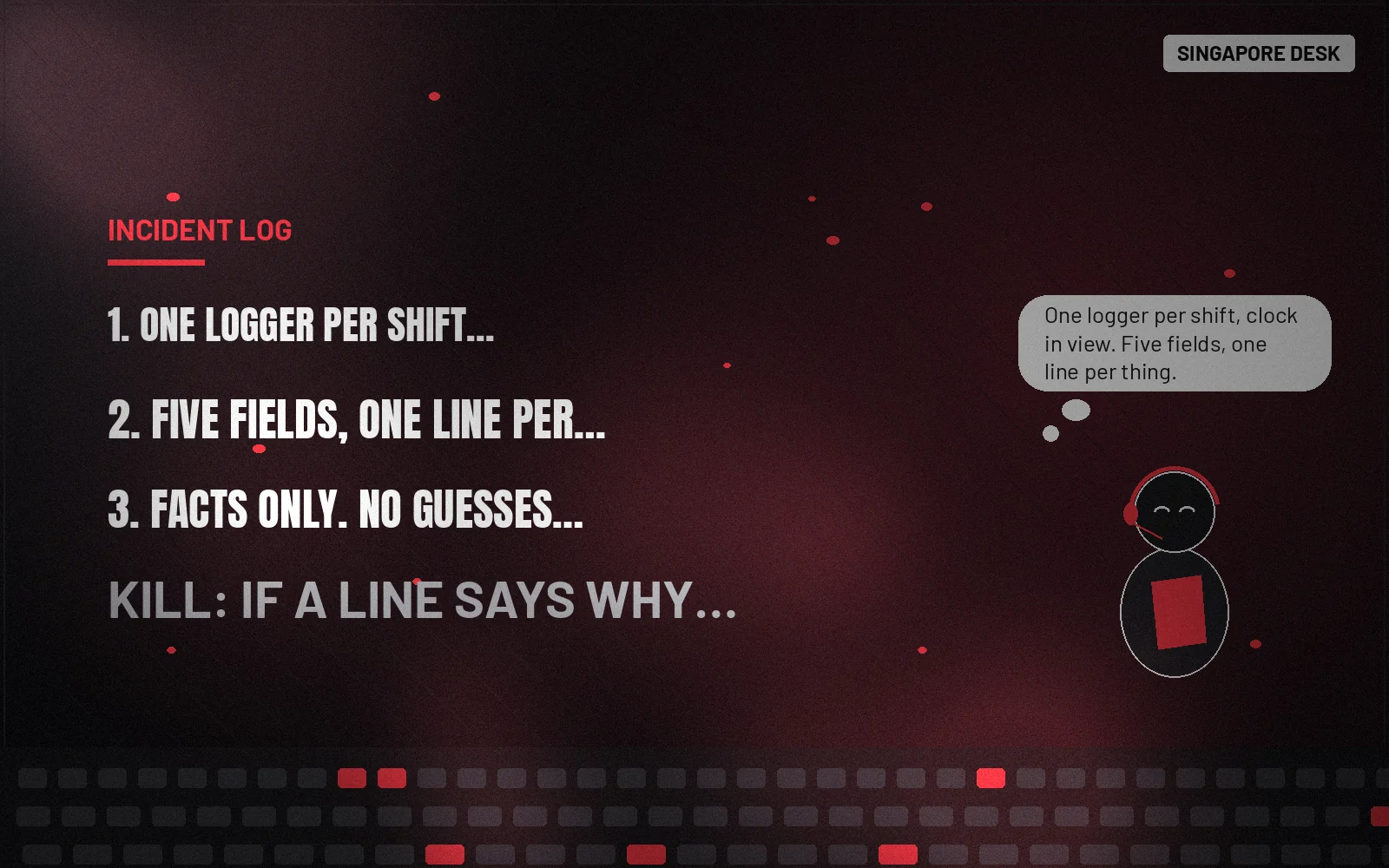
Write what you saw or heard, not what you think it meant. “Arguing loudly” is a fact. “Paid troublemakers” is a guess, and guesses stay out of the log.
Why facts, not guesses?
Because lawyers, reporters or the police may read the log later. A guess in the log becomes a claim you have to defend.
| Kill this | Say this (illustrative) | Why |
|---|---|---|
| Around eight-ish, some trouble | 20:12 · East gate · Two attendees arguing loudly | Time and place |
| Paid troublemakers showed up | Two people shouting at the stage | What was seen |
| Someone handled it | Floor manager separated them | Who did what |
| Video is somewhere in the chat | Video saved by Jo, file name noted | Where the proof lives |
| It was all their fault | Logged by Jo | Who wrote it, not who is blamed |
Who keeps the log?
One named logger per shift, at the ops desk, with a clock in view. Everyone else reports to the logger instead of keeping their own notes.
A pen and a bound notebook work. So does a shared sheet with edit history switched on. Whatever you use, lines are added, never deleted. If a line is wrong, add a new line that corrects it and says so.
What about photos, videos and names?
Reference them, do not paste them. Note who holds the file and where it is saved.
Collect personal details only if your data rules allow it and the situation needs it. Counsel confirms how long logs and files are kept and who can see them. Never post log contents or footage to a group chat.
How does this play out in PH and SG?
Same five fields. Different venues.
Philippines desk. Covered courts and plazas are open, loud and crowded. Put the logger near the sound desk with a radio, not in the crowd. Write the log in English so it reads the same for everyone, even when reports arrive in Filipino over Viber.
Singapore and wider APAC desk. Venues often have their own security and incident procedures. Keep your own lines, follow the venue’s reporting process, and log the time you told venue staff.
Paste-ready lock
The header and two example lines, ready for the logbook.
Paste-ready lock (illustrative):
“Time · Place · What was seen · Logged by · What was done”
“21:40 · Stage left · Speaker mic failed for about a minute · Logged by Jo · Spare mic handed over”
“Correction to 20:12: north gate, not east gate · Logged by Jo”
Monday field kit
- One logger per shift, clock in view.
- Five fields, one line per thing.
- Facts only. No guesses, no blame words.
- Add corrections, never delete.
- Kill rule: if a line says why something happened instead of what happened, rewrite it before the shift ends.
What to do this week
- Set up a log template with the five fields.
- Name the logger for your next event.
- Agree with counsel how logs and files are stored, and for how long.
- Practise writing one line with each floor manager.
Kill rule: if the log lives in a group chat, move it to one record today.
FAQs
What is incident log English APAC?
Incident log English APAC is the running record where each thing that happened gets one line: time, place, what was seen, who logged it and what was done. It works because a timed fact is easier to defend than a memory. It is not a press statement.
Should an incident log English APAC include small things?
Yes. A mic failure or a late speaker is worth a line, and small lines show the log is complete.
Who can see the log?
Only the people counsel and your policy name. Share summaries, not the raw log.
Can the log be quoted in a public statement?
Use it to check facts before anything goes public. Do not quote it without counsel review.
Neuwark Communications sets up event operations and crisis protocols as part of our services, including Crisis & Rapid Response. If your event nights end in four versions of the truth, talk to us at Contact. More language companions live in Insights.
Communications craft, not legal advice. Counsel checks election-period, consent and platform rules, plus data retention and privacy for logs and footage, before an incident log is used.
Related: Canvass debrief English APAC · Correction note English APAC