
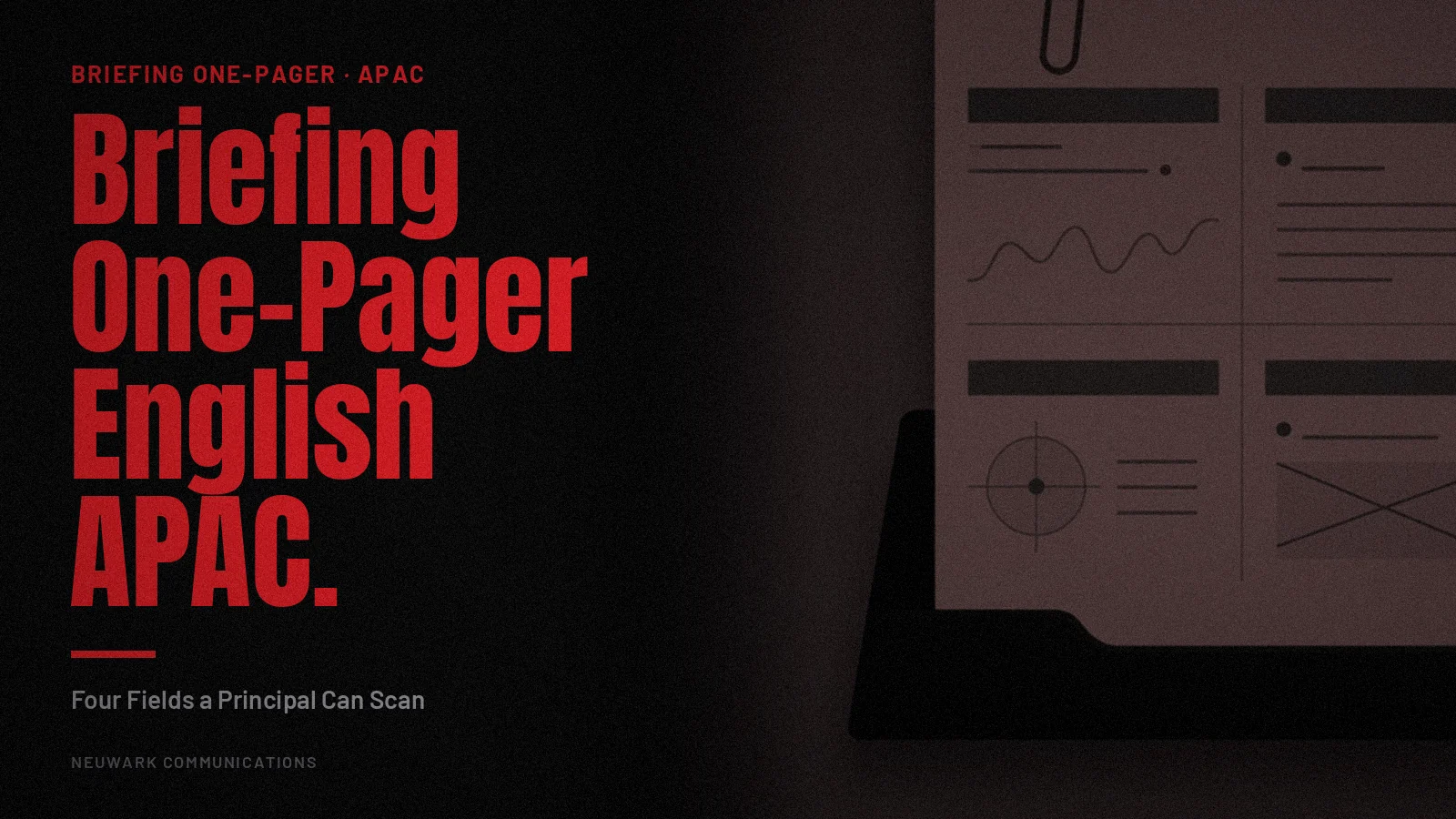
The brief was twelve pages. The lift was forty seconds.
A principal who cannot find the line will invent one. Invention is how hearings go sideways.
Briefing one-pager English APAC is four fields a principal can scan before the door: what changed, the proof, the line, the ask.
Street-smart APAC English: short sentences a tired operator can say out loud.
This cousins hearing testimony English APAC. That piece is the three minutes at the table. This piece is the page in the lift.
What are the four fields?
| Field | Job | Say this (illustrative) |
|---|---|---|
| What changed | The news since yesterday | “The department posted the contract list at 6pm.” |
| Proof | One checkable fact | “42 projects named. Source: the department PDF, page 3.” |
| Line | The sentence they may say | “The list is public. We want the missing annexes too.” |
| Ask | One next step | “Ask the chair to put the annexes on the next agenda.” |
| Kill this | Why it fails in the lift | Say this instead |
|---|---|---|
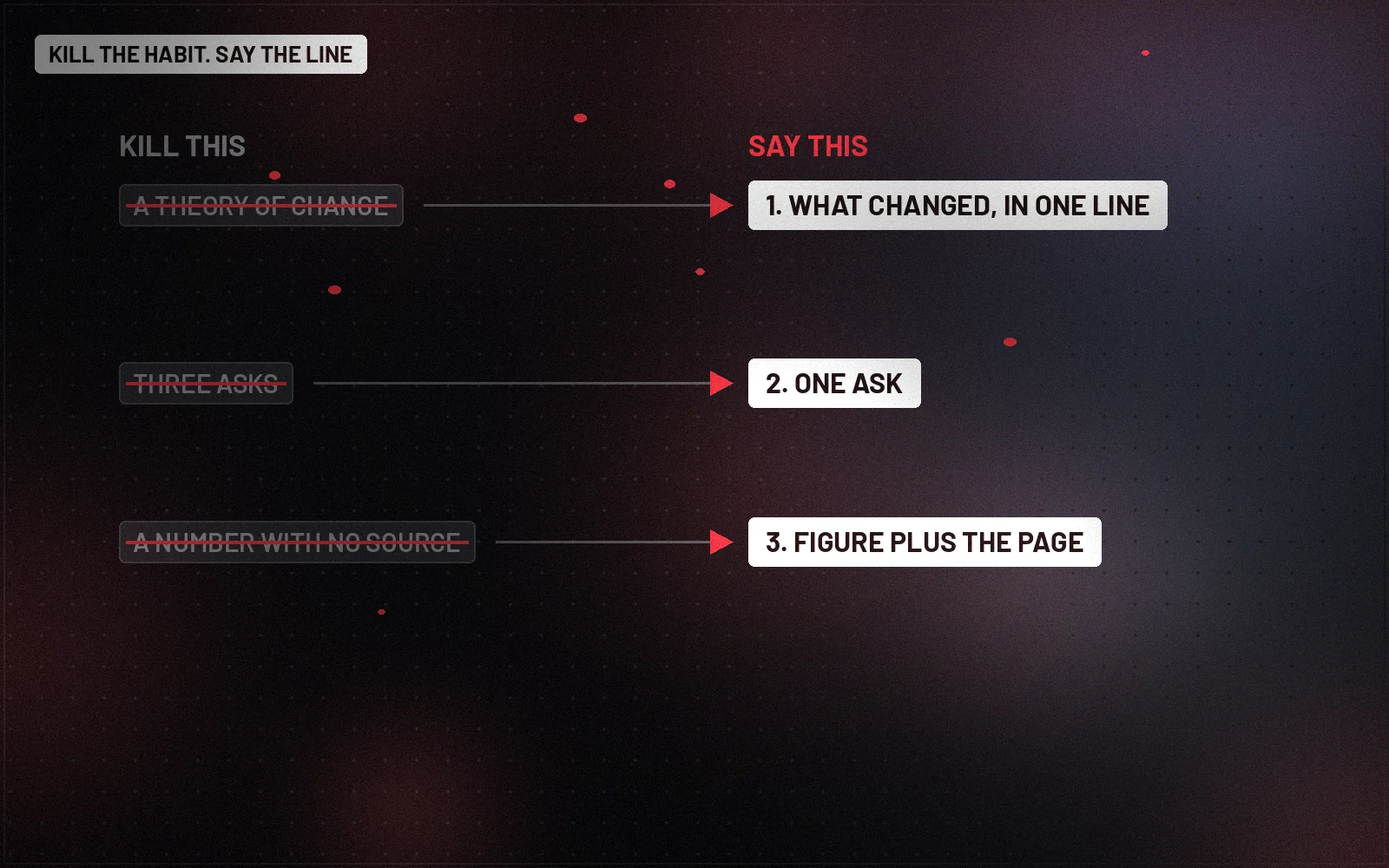
| A theory of change | No time | What changed, in one line |
| Three asks | They pick none | One ask |
| A number with no source | They will be asked where | Figure plus the page |
| Yesterday’s line after the facts moved | Becomes the clip | Update the line before the car |
What stays off the page?
Legal theory. Donor names. A second fight. A joke that only works in the office.
If it cannot be photographed in the corridor, it does not go on the page.
How is a briefing one-pager English APAC laid out?
Top line: date, time and the meeting it is for.
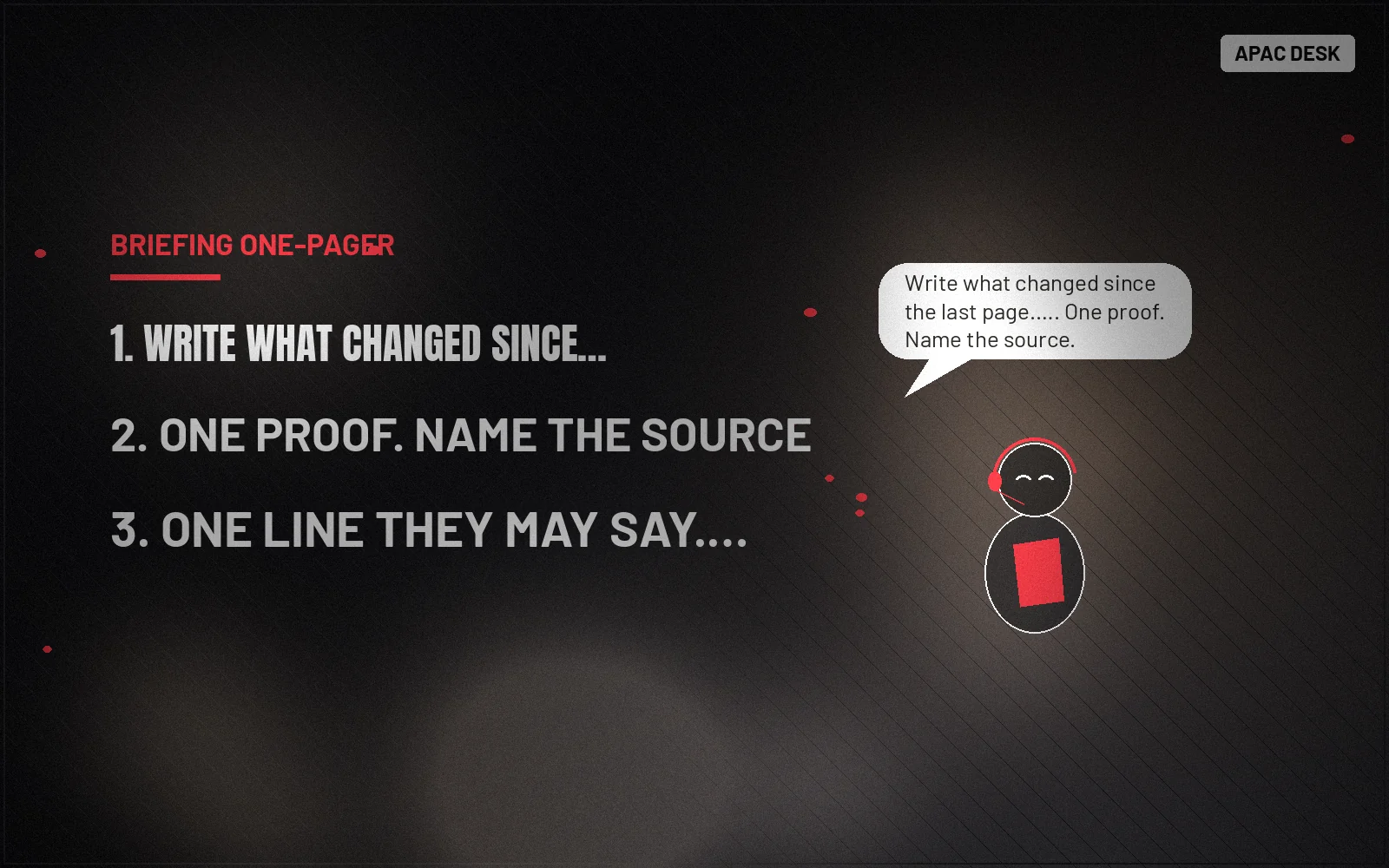
Then the four fields, in the same order every time. What changed. Proof. Line. Ask.
Big type. White space between the blocks. One side of one sheet.
The principal should be able to find the line with a thumb on the page, in a moving car, without reading glasses.
What does a good line sound like in the lift?
Read these two aloud (illustrative):
Weak: “We are deeply concerned about the overall direction of infrastructure transparency.”
Strong: “The list is public. We want the missing annexes too.”
The weak line is a mood. A reporter in the corridor cannot quote a mood.
The strong line names the object, takes the win and points at the gap. It is short enough to say while walking.
If the principal cannot say the line twice in a row without looking down, cut it again.
What about a second language?
If the principal will speak in Filipino or another local language, put the local line under the English line.
Same fact. Same number. Same ask. Two lines that say two different things are two pages, and the corridor will clip the wrong one.
Who writes it, and when?
The staffer closest to the facts writes it. The comms lead checks the line. Policy checks the proof.
Write it last, not first. The page should carry the news as of the car, not as of yesterday’s meeting.
If the facts move in the lift, the staffer says the new fact out loud. Then the page gets reprinted for the next door.
How do you hand it over?
In the car, not at the door. Hand it face up, with one sentence: what changed since they last heard.
Do not talk through all four fields. They can read. Point at the line and the ask.
Keep a second copy for yourself. When the meeting ends, mark what got said and what got asked. That marked copy is the start of the next page.
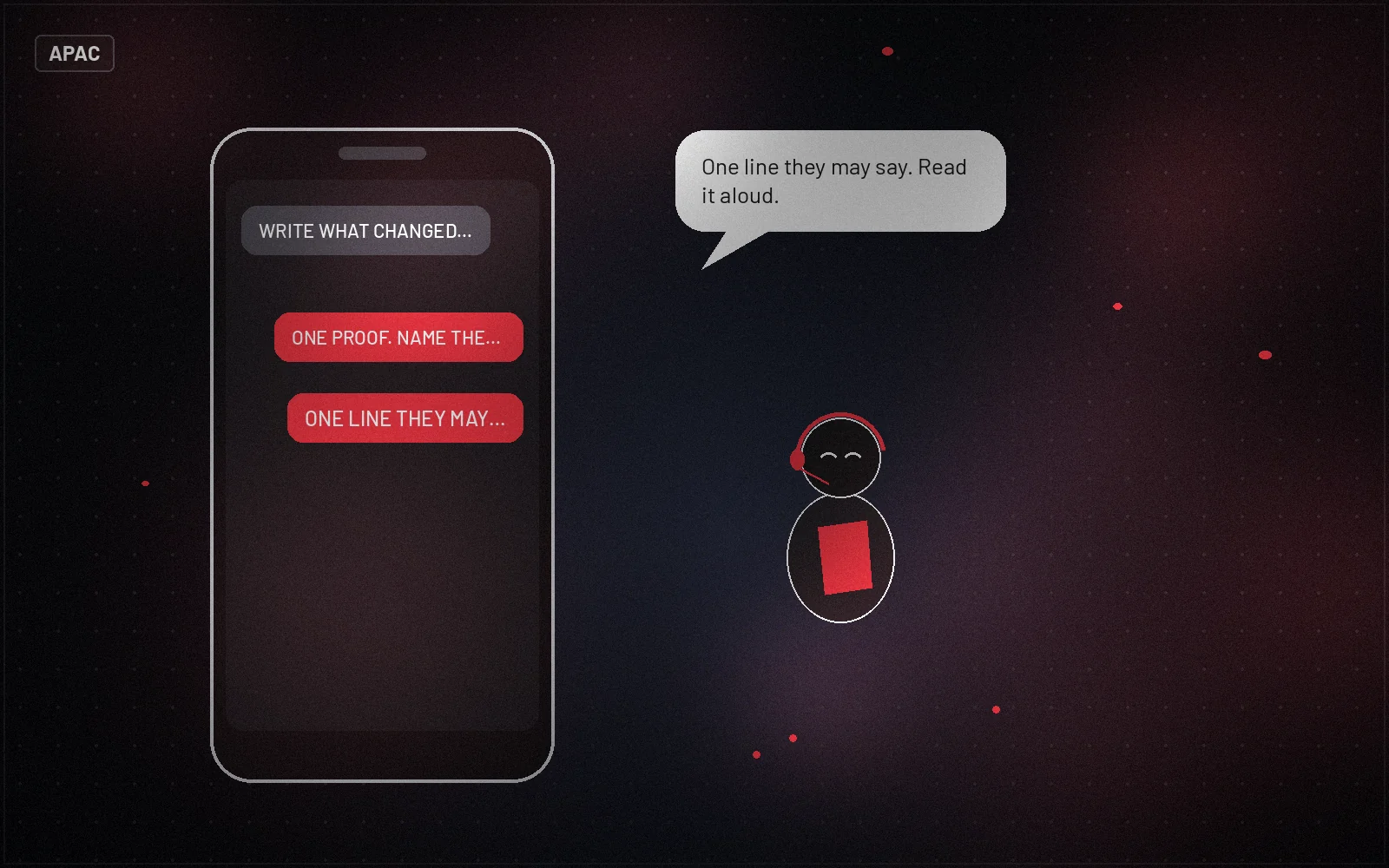
If the principal is remote, send the four fields as plain text in the chat they actually read. Not an attachment they have to open.
What about a principal who wants more?
Give them the one-pager first, always. Put the long brief in the folder behind it.
The one-pager is the map. The long brief is the territory. Principals who want depth will turn the page. Principals in a hurry will not have to.
Never put the only copy of the line on page seven.
What if the principal goes off the line?
It happens. The one-pager reduces it. It does not end it.
Afterwards, do not argue the line in the car. Note what was said, check whether it is now the clip, and update the next page. If it created a factual problem, the correction goes out the same day, short and plain.
Monday field kit
- Write what changed since the last page. If nothing changed, say so.
- One proof. Name the source.
- One line they may say. Read it aloud.
- One ask. Kill the other two.
- Date the page. An undated page is yesterday’s page.
FAQs
What is briefing one-pager English APAC?
It is four fields a principal can scan in a lift: what changed, the proof, the line, the ask.
Is this the testimony?
No. Testimony is the spoken three minutes. The one-pager is the page that keeps those minutes on the line.
How often do you reprint it?
When the fact changes. A stale line is worse than no page.
Can the one-pager be digital?
Yes, if it reads on a phone without zooming. Same four fields, same order. A PDF that needs pinching is a twelve-page brief in disguise.
What to do this week
Take the last brief that went into a car. Count the asks. If there are more than one, cut to the four fields before the next door.
Neuwark Communications builds principal language under Strategy & Messaging and Public Affairs. If the brief still needs twelve pages to find the line, talk to us at Contact. More language companions live in Insights.
Communications craft, not legal advice. Anything on the page about a pending case, a contract or a named official goes past counsel first.
Related: Hearing testimony English APAC · CRM field note English for CSO hearings · Press availability English APAC · Desk-ready pitch email English